Building a Culture That Lasts
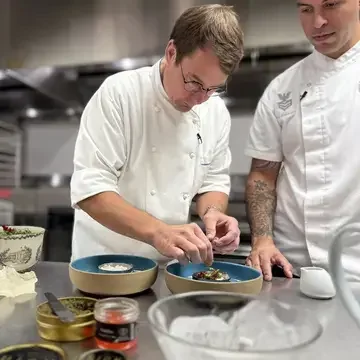
Providence’s endurance is about people as much as dishes. Several team members have been with Cimarusti since day one, from captains and hosts to runners. “At our anniversary party, I gave a speech focused on that group,” he says. “Because the truth is, you can’t do it all.”
“We built a culture here where kindness, respect, and precision must coexist,” Poto says of his longtime team. “And that’s the way to make it work.”
For young chefs, the temptation is to control every detail; Cimarusti argues the opposite leads to long-term success. “The most valuable lesson I’ve learned is to allow people to grow into the space you give them. See their talents, encourage them, and build on them.”
He cites a sous chef whose passion for fermentation has reshaped the menu through koji-driven projects. “That’s not part of my repertoire. But when you give someone the tools to follow what drives them, they can create something that changes the restaurant. As a leader, you can’t see that as a threat. It’s a gift.”
If Providence has matured, so has its city. Today, Los Angeles counts restaurants that embrace heritage-driven fine dining, from Jon Yao’s Kato to Restaurant Ki. “Twenty years ago, those places didn’t exist,” Cimarusti notes. “Now young chefs are trained in French or European kitchens and then turn back to their own roots to find identity. That’s why Los Angeles leads in so many ways. It’s fertile ground for that kind of growth.”
Asked about Providence’s future, Cimarusti dismisses any talk of retirement. “I don’t feel like we’ve done our best work yet. I still love being in the kitchen, teaching young cooks, and mentoring. As long as I feel that drive, I’ll be here.”
More and more, his attention turns to another frontier: sustainability. “When I was younger, I thought sustainability was just about ingredients. Now I understand it’s holistic. It’s how we reduce waste, how we bring less plastic into the world, how we tread lightly on this planet. Change comes incrementally, but it’s something I think about all the time.”
For a generation of chefs chasing stars, his advice is blunt but generous: focus less on proving yourself and more on building a culture where others can thrive. Don’t underestimate the unglamorous foundations: lawyers, leases, and long-term partners. Above all, understand that success isn’t measured by years alone but by the people who stay by your side.
“Twenty years ago, I wanted to do too much,” he reflects. “Now I know it’s about letting the ingredients, and the people, do the work.”