“I woke up knowing I would cook.”
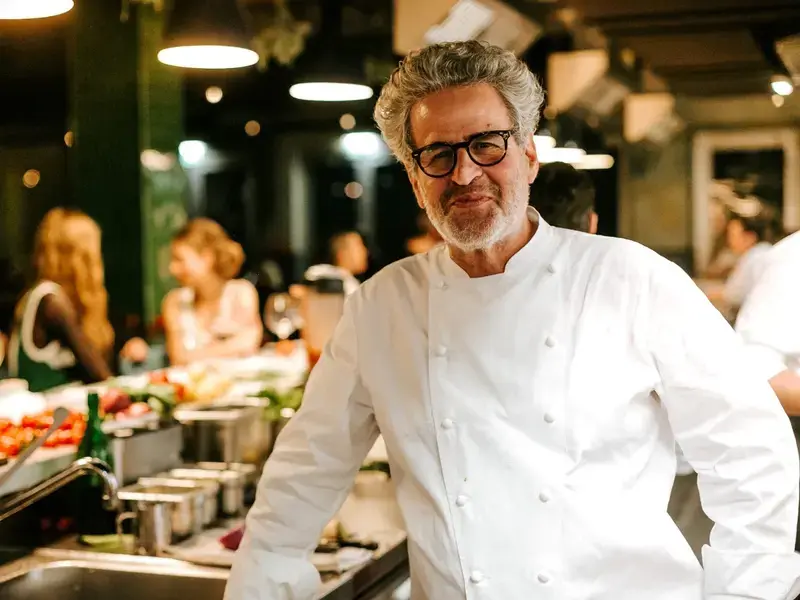
Chef Eyal Shani still describes the moment with quiet certainty. More than forty years ago, after finishing his military service, he retreated to a remote farm in northern Israel to live alone. Heartbroken after a failed relationship, he spent his days harvesting food from the land, cooking over open fire, reading, and singing to himself. “I lived like a priest,” he says, trying to understand the pain of the separation that had brought him there.
One night, friends arrived carrying six freshly hunted porcupines and several bottles of red wine. They roasted the animals over a fire and drank late into the night beneath a full moon. At some point Shani collapsed into sleep in the open field. When the sun rose the next morning, he woke with what he describes as a complete clarity about his life. He would become a cook. “It was not a decision,” he says. “I decided nothing.”
Today Shani presides over a global collection of restaurants that stretch from Tel Aviv to New York, Paris, Melbourne, and Singapore. Yet his approach to food still sounds less like the language of business than the language of philosophy. For Shani, every ingredient carries its own identity and purpose. A tomato is not simply produce. It is a singular presence that cannot be replaced. The work of the cook, he believes, is not to control ingredients but to listen to them.