Sorry, you need to enable JavaScript to visit this website.
Brandon Go

One Meeting, One Time at Hayato

12 Minute read

At Hayato in Los Angeles, chef Brandon Go pursues a deeply personal vision of Japanese cuisine shaped by memory, repetition, and the fleeting connection between chef and guest.

Somewhere, in the mind’s eye, rests the Platonic idea of an oyster. You can’t help it (says Plato); there it is: barnacled and popped open to a buoyant flesh as saline and smooth as high tide. There is no pierced-oyster-flesh snot, no calcite shell crunch, no lukewarm body. It is only Oyster, the original and perfect mold.

“When I see an ingredient, I’m thinking about making that one bite that just says: this is oyster,” Brandon Go explains. “This is crab. This is abalone.”

For the chef and owner of Hayato, a seven-seat kaiseki counter quietly tucked into ROW DTLA, the pursuit of Platonic form has made his restaurant one of the most famously difficult reservations to secure in Los Angeles.

And for good reason. Go’s measured approach to kaiseki, a cuisine whose lineage stretches back through 600 years of transformation through Buddhist temple cooking and the aesthetics of the tea ceremony, takes form in dishes that are as deceptively simple as meditation. Ingredients are pushed and pulled by fire, knife, or water only insofar as necessary to tune their character, violin-string tight, into perfect key.

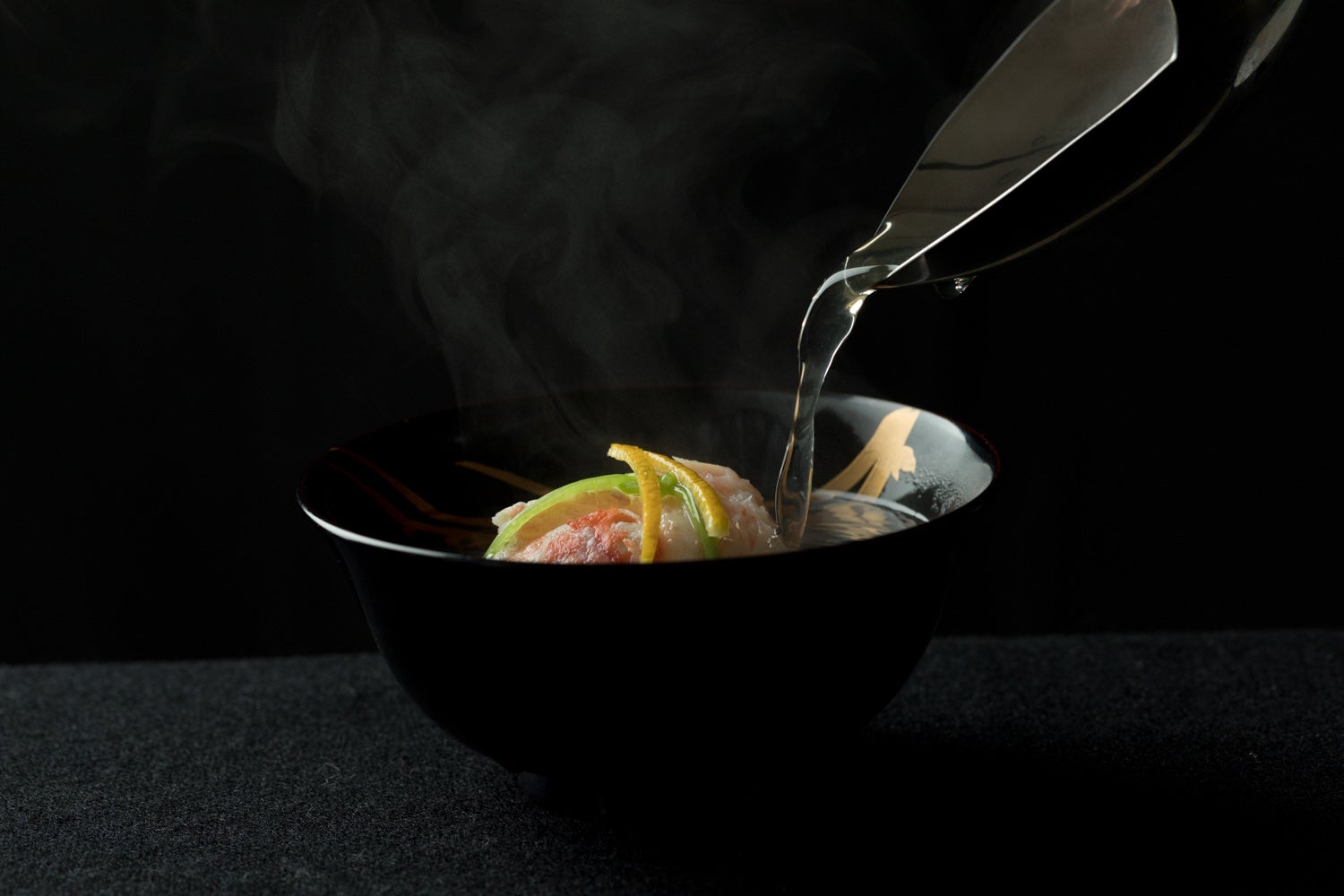
Owan

Hayato's Owan 

The Ideal Ingredient

With kaiseki’s emphasis on shun (seasonality), the menu may pair corn with Hokkaido scallop as a kakiage tempura, grill fresh mehikari over charcoal, or lightly smoke tiny hatsu-gatsuo, the first bonito of the year, over rice straw, depending on the moment in the calendar.

“The more I think about the way I approach food and cooking now, the more I think my dad’s opinions really shaped the way I think about food and cooking in general,” Go says. “Even before I was working with him.”

From the age of fifteen, Go worked after school, on weekends, and through summer vacations alongside his father, Kunio Go, at Koi, his Japanese restaurant in Seal Beach. While that time instilled technique and discipline, it was less the labor itself than the stories surrounding his father’s most treasured meals, scattered across the globe, that formed Go’s internal eye.

“Whenever we ate, my dad just liked to talk about food,” Go recalls. “He would tell us about the best version of that thing he had ever had. It was at this time, in this place, it was this color. If we were eating oysters, he would say, ‘The best oyster I ever had was at this place and it was this flavor and this brown and this and that.’ He would tell the same story over and over again.”

Those stories, repetitive, precise, unwavering, etched an ideal into Go’s mind. “For him,” Go says, “all these taste memories were almost all very straightforward. Simple flavors of natural ingredients.” Within Go’s deeply seated focus on natural simplicity, there’s one obsession that rises above the rest: dashi.

“I think about dashi so much,” Go admits. “The more I think about it, the more it controls everything we do.” He travels to Japan three times a year, eating at places he describes as true masters, only to return home unsettled. “I just cannot get the flavor. It’s not even a flavor. It’s some kind of feeling that it gives you when you sit on the seat that is really hard to replicate.”

What draws him to dashi, Go says, is its depth. “I think the reason people get so interested in beverages, and the reason that dashi is so interesting, is that the level of complexity you can taste in a liquid far exceeds any solid food.” Like wine or sake, a masterful dashi can speak of time, place, fermentation, and age. “It’s impossible to describe the flavor of it,” he says. “And the more I try to control it, the more difficult I realize it is.”

When a chef devotes themself to repetition, a shokunin in pursuit of an ideal, it becomes easy to flatten them into an abstraction. Go, his squid-ink-black hair slicked back, a yin to the yang-white of his samue chef’s uniform: stoic, remote, one-dimensional. Few spaces reinforce that projection more readily, particularly for those arriving with a Western frame of reference, where cultural nuance can quietly give way to the fetishization of discipline, than the pale hinoki counter separating guests from the itamae, an honorific meaning “the one in front of the board,” moving through motions so practiced they can appear ceremonial.

But what makes experiencing Go’s work exceptional is not the romance of striving for an impossible ideal alone. It’s understanding the unromantic humanity required to sustain that pursuit.

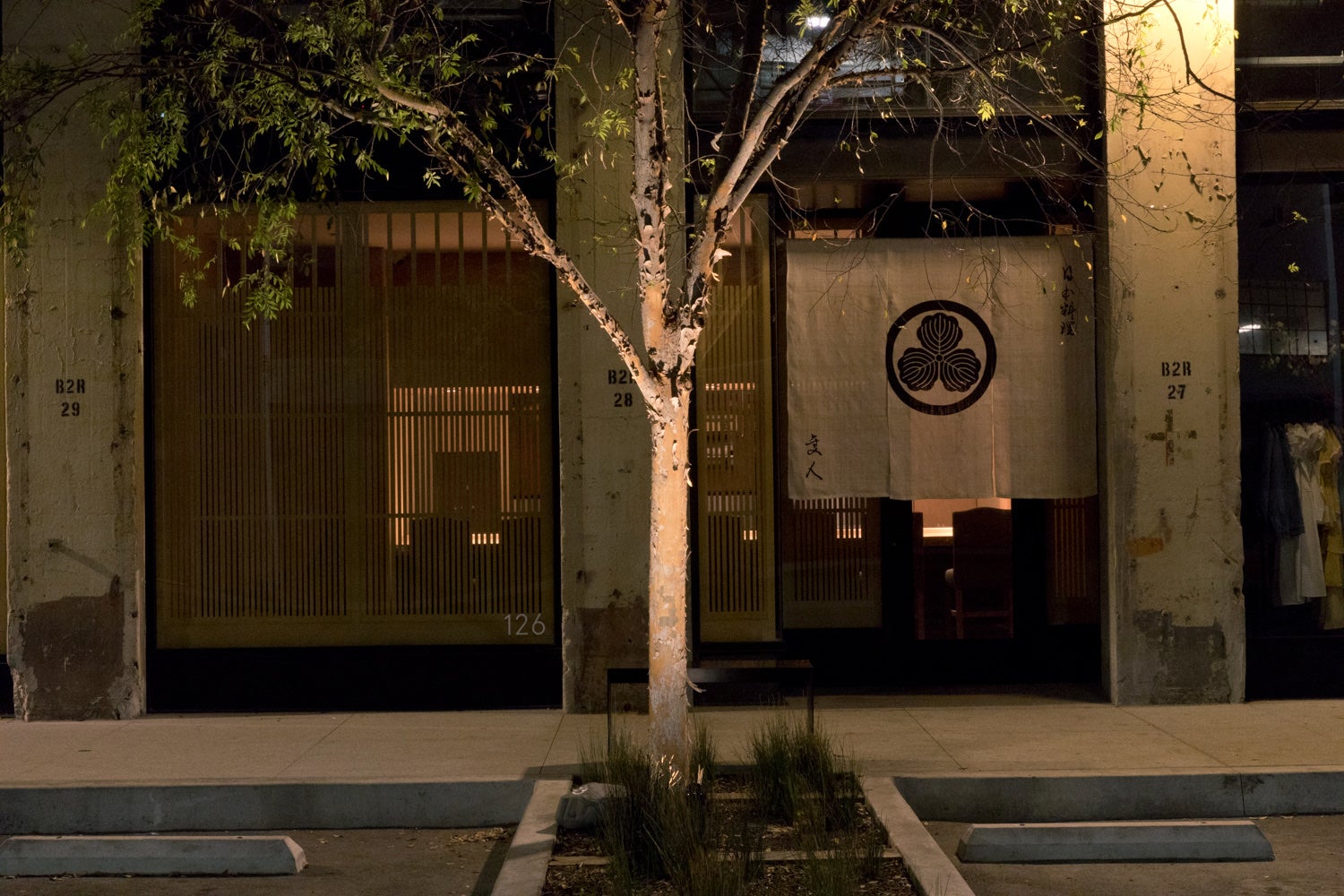
Hayato Exterior

Hayato Exterior

The Work Behind the Counter

“My life has been six days a week, a minimum of twelve hours a day, inside of a restaurant,” Go says. “It’s like thirty-two years at this point. I think it’s just shaped my personality to where I’m more comfortable inside of a restaurant than outside of one. It just feels like home.”

That sense of the restaurant as home, as a safe space, extends beyond Hayato itself. “It’s not just my restaurant,” he says. “It includes other people’s restaurants too. You just feel like everything’s the way it’s supposed to be. All the people around are doing what they’re supposed to be doing. That dynamic sometimes goes away when you go out in public or go to somebody else’s house.”

The romance dissolves further when Go talks about time. Not in theory, but in the way it slips away from him. The hours required to clean, to sharpen knives, to handle administration as an independent owner-operator. The difficulty of outsourcing even small tasks. The way, after forty, the body speaks up for itself now; it won’t take no for an answer. And on the days that might otherwise pass for rest, there’s another responsibility that matches Go’s care for the restaurant: his father. On his “days off,” in between the many clerical necessities of keeping his restaurant running, Go spends his time in the car with the man who told him about the perfect oyster, taking him back and forth to his growing number of doctor’s appointments.

It’s in this same plain register of hours, repetition, and care that Go speaks about knives, not as fetish objects, but as a lifelong problem, akin to a Buddhist kōan puzzle, that he is still trying to solve. “The real thing I spend so much time working with and thinking about are knives,” he says. The deeper he’s gone, the more unbelievable the stakes feel. “It’s not just the form of the knife, the steel that you use, the way you’re sharpening, the sharpening stone you use, the way you cut things. It completely can transform some ingredients.”

Go describes hearing about a restaurant in Japan (one he hasn’t been to, only heard about) where the premise is almost aggressively specific: the same vegetable sliced in different ways, such as a pull cut versus a push cut, and diners swear the taste notably changes depending on the cut. Whether or not you take that claim as literal truth, it reveals a certain kind of mind, one that believes flavor is not only in the ingredient but in the force, angle, and edge that meets it.

Go’s own day begins accordingly. For the last seven years, he’s done much of the prep himself. “The first thing I do when I wake up in the morning is I go in and I start cutting fish and cutting vegetables,” he says. “I usually start the day with sharpening knives.” And that, he admits, is part of why relinquishing control is so difficult. “A lot of things I’m doing, I feel like I’m just starting to get it right myself over the last few years.”

Young cooks come to learn, drawn by the romance of skill, only to collide with the unromantic timeline it demands. He describes them trying to take on a garnish, then stalling out and reaching for an explanation that sounds like a shortcut: “Chef, can I use your knife? I could do it if I used your knife.” But for Go, the knife isn’t the secret; the years of sharpening it are.

“It’s learning how to sharpen the knife to go to the limit that you have to to be able to cut certain things,” he says. “It takes much longer than learning the cutting.” Without the years spent struggling through stones and edges—trial, error, repetition—“you’ll never be able to do it.” In some cases, he says, that learning curve is “two or three years,” and often longer.

At thirty-two years with a knife in hand, Go’s time with a blade is a meditation, the alchemy of turning practiced physical work into a new headspace. “As soon as I pick up a knife,” he says, “anything that’s been stressing me just kind of goes to the back of my mind.” He describes the tactile work, hands on board, blade through product, as a kind of nervous system reset, akin to the way a yoga practice can shift the mind the moment you touch the mat. “I just put my phone away,” he says. “I’m just at my chopping board.”

It is here, where philosophy meets labor, that Go arrives at tea. “I’ve been going to tea ceremony classes a lot,” he says. Within that world, he explains, there is a phrase: ichigo ichie. One meeting, one time. No encounter can ever happen again in the same way.

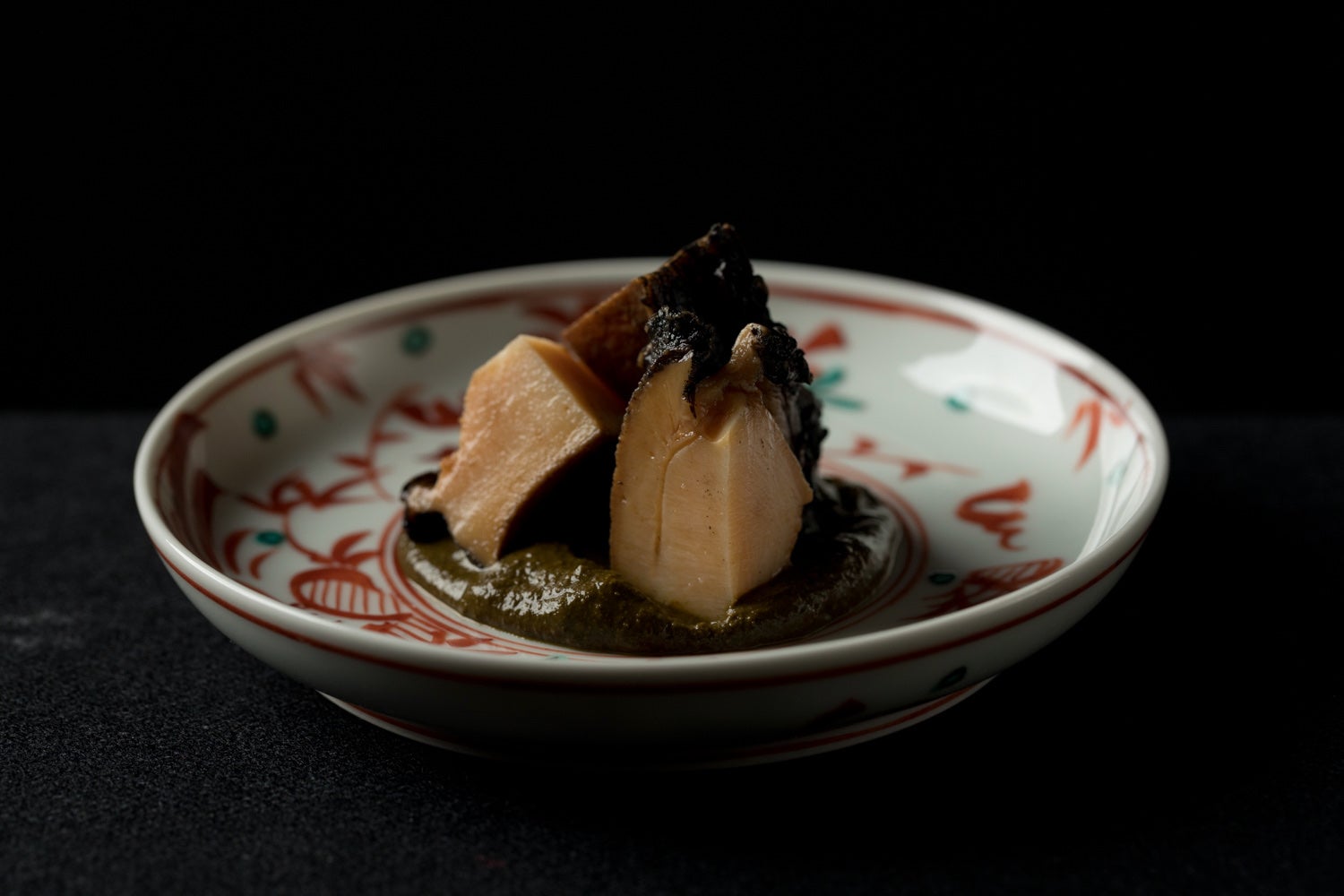
Awabi

Hayato's Awabi

One Meeting, One Time

In tea ceremony, meaning is never carried by the host alone. “The guest plays half the role,” Go says. “The host plays half the role too.” What unfolds exists only through shared attention. The philosophy quietly dismantles the familiar binaries that cling to fine dining—romantic versus unromantic, ritual versus work, performance versus reality—replacing them with something less theatrical and, perhaps, more difficult: mutual presence. “That’s why when the customers reciprocate something with the staff,” he says, “you can create this really special thing that’s impossible to replicate over and over again in the exact same way.”

At Hayato, Go wakes up each morning and looks at the guest list for that day. If you’re one of his guests for the day, he spends his whole day thinking of you. “The day is just about those people,” he says. “I try not to think about the day before or the day after. It’s just: do the most with every day.”

Seen through that lens, the Platonic oyster, the perfect dashi, the relentless repetition all resolve into something unexpected: a place where neither side of the coin, the romantic vs. unromantic sides of Go’s life, really gets to the heart of the story. In the end, Hayato is not a temple to either so much as a series of unrepeatable meetings, between chef and guest, knife and ingredient, moment and memory, each occurring once and only once.

And then, when the last perfect Harry’s Berries strawberry or watering slice of yellow melon has been eaten, Go will lead you through the door, bowing with respect for as long as it takes you to walk down the street. You’ll pass the many shops and restaurants and, as the rest of the world bleeds back into you, note, upon turning back, that he’s still there. A glimpse of him, just before you round the corner, before he slips with the rest of it back into the place where it will always live: in the eye of your mind.

Spread the flavor - share this story.

Join the community
Badge
Join us for unlimited access to the very best of Fine Dining Lovers
Unlock all our articles
Badge
Continue reading and access all our exclusive stories by registering now.

Already a member? LOG IN