You have a right to express yourself. You have a right to be comfortable. You have the right to express your culture, even if that culture is the band Phish. You, in short, have a right to be a jerk.
And restaurants have a right not to let you in.
When Ruth’s Chris Steakhouse updated its website to remind diners of its dress code, people got upset. Which was weird because Ruth’s Chris is not asking much. Guests cannot don “gym wear, pool attire, tank tops, clothing with offensive graphics or language, revealing clothing or exposed undergarments.” The controversy mostly stemmed from Ruth’s Chris banning baseball caps in the main dining room. Chili’s, never one to avoid a fight, especially in its parking lots, responded on social media that “the only dress code at Chili's is that you have to be dressed.” I am surprised they chose to bring this up, since Chili’s has needed to enforce that rule several times with its own employees. And its customers.
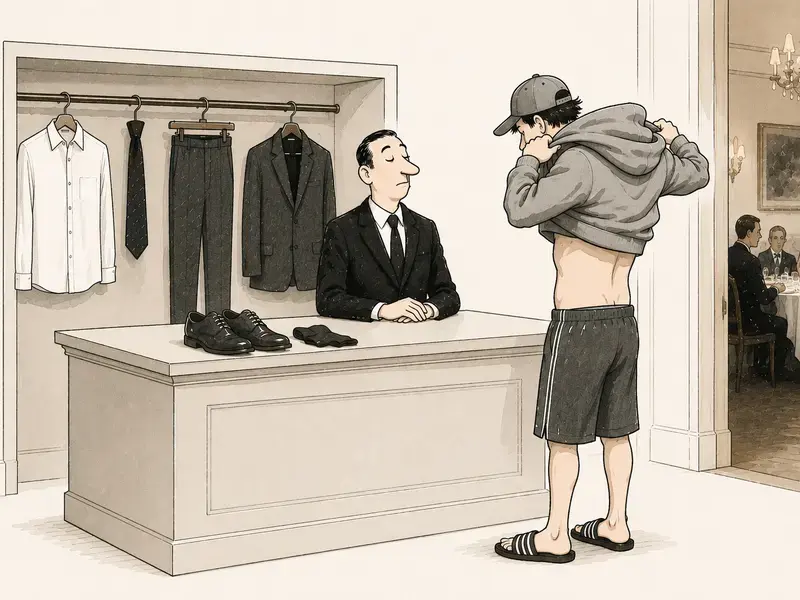
Dress codes were once much stricter. In the 1960s, New York socialite Nan Kempner (a woman so fashionable that Vogue editor Diana Vreeland proclaimed, “There are no chic women in America. The one exception is Nan Kempner”) was turned away from La Côte Basque for wearing pants. So she unzipped them, handed them to the hostess, and hoped her long suit jacket would cover enough of her, since she was wearing what she called “her summer underwear.” A phrase she later explained to The New York Times meant she wasn’t wearing any.
I didn’t think of that in 2006 when I wandered with Al Franken and Walter Isaacson after a Manhattan book party toward the 21 Club. While I was wearing a jacket and tie, I was turned away at the door for donning dark blue jeans, which I didn’t have the foresight to unzip and hand to the host. We ate elsewhere. It was not the worst thing that would happen to me. And definitely not to Franken.
A few weeks ago, I was with my wife at Little Fish, a place nice enough that they set wine glasses on white tablecloths at lunch. Three women entered wearing Alo leggings and bra tanks. Two of them donned fluffy slippers. They had unzipped before arrival. And we endured them.
Of course restaurants should have dress codes. No one wants your authentic self outside of your house. Besides, there’s no authentic self. You’re a different version of yourself all the time. You speak differently around your grandmother than your frat buddies. You dress differently for a funeral than for a football watch party. When you’re at a fine dining restaurant, your self may be in the line of sight of someone proposing or making a crucial business deal. So you dress up.
This is not a financial issue. The dress code does not require an expensive jacket and tie. And your $3,000 Balenciaga hoodie will not pass. This is not your own fashion show.
The dress code is a polite way to ask you, at least for this night, not to be a gross crypto douchebag. To be restrained. To be a bit repressed. To be an adult.
I get that clothing can cause the kind of class anxiety that David Brooks is always fretting that the elite are imposing through cultural signifiers. But every culture dresses up for certain occasions. And part of the thrill of fine dining is entering another culture.
At Mastro’s Steakhouse and Ocean Club restaurants, where waiters wear white tuxedo coats and the website proclaims that it is “a place where the food is exceptional but almost secondary to the feeling... Where arriving feels like an event and leaving feels like a loss,” you better believe there’s a dress code. “It sets the tone for the room. It’s part of everyone’s communal experience,” explains Patrick Barrett, Mastro’s divisional vice president. Hosts mention the dress code when they call to confirm reservations, and the website says the restaurant bans athletic wear, baseball caps, and visors, while appreciating “collared shirts and/or sport coats.” Dressing for the occasion is a sign of respect for the people who work to such a high standard there. It is basic manners. “If I wore a ball cap to the table, I know what my dad would have done to me,” Barrett says.
In addition to enforcing the dress code, Mastro’s hosts are responsible for an imperceptible, polite policing of cursing, yelling, and all forms of misbehavior that would ruin “the feeling.”
Are dress codes racist, sexist, and transphobic? Of course. Everything is racist, sexist, and transphobic. But that doesn’t give you an excuse to get rid of them. Voting in this country was unjust until 1965, but the solution wasn’t to abandon democracy.
This is what Stanford Law School professor Richard Thompson Ford learned while writing his 2021 book Dress Codes: How the Laws of Fashion Made History. “I began the project from the perspective of a legal scholar who studied civil rights. My gut impulse was to side with the litigants objecting to these dress codes. Wouldn’t it be better if we could get rid of them? I found it was much more complicated,” he says.
“Everyone in the civil rights movement was expected to dress in their Sunday best. And that was an incredibly powerful call for respect and rights.” Ford also found that some restaurants discriminated against hip-hop culture, using a “no sneakers” policy to reject people wearing brightly colored Air Jordans while allowing in those wearing gray Allbirds. Yet some of the people making those decisions were Black owners with Black clientele. “They were bougie Black folks, and they didn’t want the hip hop-influenced people,” he says.
Ford is pro-dress code. He cites a point he heard from the dapper director Paul Feig: If a restaurant has spent millions on interior design to create an atmosphere, you should realize that you’re part of the scenery.
He believes this despite the fact that he, too, met resistance at the 21 Club when he was a law student at Columbia University. Luckily, he wasn’t wearing jeans, so he was able to borrow a jacket and tie. For a long time. “I still have the 21 Club tie. It was a pretty common thing in college where people had 21 Club ties,” he says.
But in our capitalist society, diners think of themselves as consumers rather than community members in a shared space. Fine dining is a cold exchange of cash for service. To them, purchasing a three-course meal at a restaurant is no different from DoorDashing and requires no special outfit. They are kings. And servers are servants.
There’s a theory in economics called motivation crowding. It states that once you involve a monetary exchange, people feel entitled in a way that they wouldn’t if there were no cash involved. The money crowds out all other motivations. If you ask the person in front of you not to recline their seat on a plane, they’ll probably abide. But if you offer them $5 not to recline, they’ll either refuse or ask for more money. Ford wonders if, similarly, the restaurant check gets in the way of good manners. “Maybe it would be different if it were a party in someone’s private home and they said, ‘I’m asking you to dress for the occasion.’ Though the dynamic is the same,” he says.
When Stefano Cremasco was creating his new Miami restaurant, 1986 Steakhouse, he debated whether to have a dress code. “We’re doing French service, so there were people within the group who argued for it,” he says. Cremasco grew up in the Mexico City branch of Cambalache, his father’s 40-year-old chain of Argentine steakhouses throughout Mexico. In Mexico, he says, diners dress up without being given a dress code. Which is not the case in Coconut Grove, where Cremasco opened 1986 Steakhouse. “We wanted to make it feel welcoming to people in the neighborhood,” he says. He isn’t worried that anyone in Coconut Grove is going to have their special occasion ruined by a Tommy Bahama shirt. “If someone comes in with a scuba suit, we’ll talk about it,” he says. “I guess I would say no transparent clothing. I saw that somewhere.”
Will Beckett, the co-founder and CEO of Hawksmoor, a chain of seven high-end steakhouses in the U.S. and U.K., says that the row over dress codes is silly, since lovers of fine dining can choose their own adventure. When you create your restaurant, he says, you hit a fork in the road. “Simon Kim [the well-dressed owner of COTE Korean Steakhouses] and Kevin Boehm [the well-dressed co-owner of Boka] turn left. They work up a professional, slick version of themselves. People like me turn right,” he says.
A restaurant is an extension of the person who runs it, and Beckett is a man whose wife is always pointing out the toothpaste on his sweater. So not only do his diners wear whatever they want, but so do his servers and hosts. “I used to feel that there was a fundamental tradeoff that you were yourself on the weekend and changed your vocabulary and the way you dressed to be at work. I didn’t like that. I like the idea that you could go to work and be your true self,” Beckett says. “When people ask what my restaurants are like, I always say, ‘We are the most unusual combination of high standards and casualness.’”
Then he says something devastating on our Zoom. I’m conducting our interview as a professional, having slipped on my button-down Zoom shirt. But he says this: “You could easily work front of house at Hawksmoor with what you’re wearing.”
That’s right. I’m a poseur. I like dress codes not because I dress well, but because I aspire to be a person who dresses well.
And apparently, there are more of us. “In London and New York, there’s a swing back to dressing a bit smarter,” Beckett says. So he’s about to institute a new rule for the staff. “We’re exploring tightening up a little bit. You can wear your own clothes but wear an apron so there’s something uniform.”
I know institutions and customs are falling apart. I know I’m arguing for playing violin while the Titanic goes down and Rome burns, and your restaurant is being gerrymandered into two different districts. But isn’t that what fine dining is? A chance, at least for part of a night, to be in a better place? I’d rather wear a tie for that than a job interview.