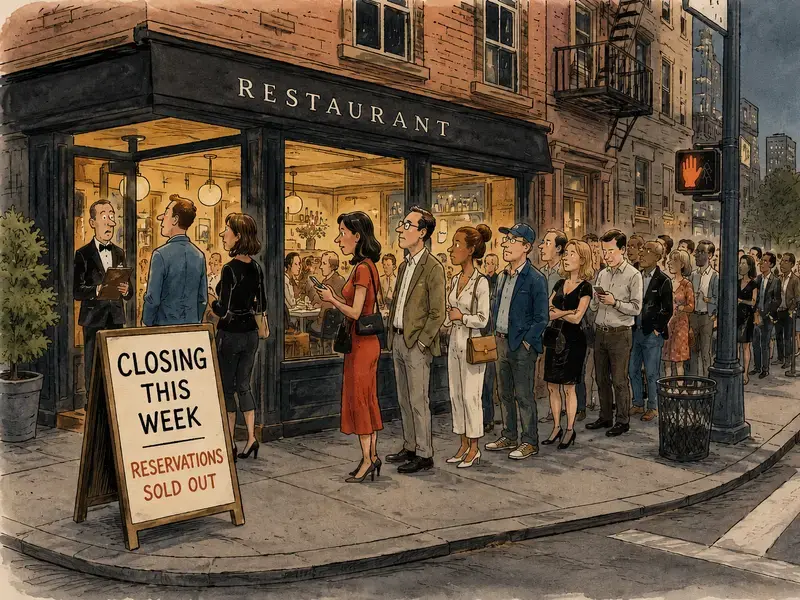
Few things embitter a chef-restaurateur more than the gushing, long-lost guests who float back like apparitions for one final repast in the days or weeks before an announced permanent closure.
The pained, increasingly common refrain goes something like this: “If all these people telling me how much they’ll miss me had just come in once or twice a year, I wouldn’t be closing.” (It’s safe to imagine our unnamed composite chef roaring the italicized words like the late comic Sam Kinison, or post-Scent of a Woman Al Pacino.)
That might be a slightly rosy view of the recent past. The deceased and the moribund probably hadn’t been in robust health for a good long while. But the sentiment holds.
There’s something we can all do to help mitigate a restaurant’s fate.
Before getting to it, a few observations:
I often reflect on a conversation I had with Jeremiah Stone and Fabián von Hauske Valtierra during the intoxicating first year of their Contra restaurant in Lower Manhattan. Around that time, a few fabled warhorses of the late 20th century were turning thirty: Gotham Bar and Grill, Tribeca Grill, and Union Square Café. (Two of the three have since shuttered for good.)
I asked those two young bucks, smiling and yawning in equal measure amid that first blush of fame, if they dreamt of being around as long as those hits of yesteryear.
Jeremiah responded that he found it challenging to even contemplate a three-decade tenure. He offered the for-instance of wd-50, which had just recently bowed after 10 years. In his eyes, that was a success. For him and his contemporaries, he believed, it was more a matter of operating in the moment, with a solid team and enthusiastic customers, paying back your investors, then possibly moving on to the next emergent restaurant neighborhood, with its affordable rents and appreciative residents.
"Maybe that’s the new thing,” he said.
Those words proved portentous. Contra, in its original iteration, closed after exactly a decade.
And I agree with 2015 Jeremiah. That’s a laudable run by today’s standards, when even the hottest new thing descends through multiple cycles, as though through the rings of Hell, from 24/7 Notify status to bookable on weeknights to a 50-50 chance of walking in to “we’re closing in three days” in record time. Pack it in any time after your restaurant’s second anniversary today and, while many will mourn on your behalf, few will consider your venture a failure. Last half a decade or more and, no matter how sharp the sting, you had what most peers would consider a good run. Put another way: “Five is the new Thirty.”
In defense of diners: There are more restaurants, and more restaurants of note, than ever before. Competition is fierce, and diners are bombarded with temptations every time they whip out their phones and start scrolling through social media. It’s easy to get so caught up in the churn of new places, or the rat-a-tat-tat of pop-ups and residencies, and the desire to avoid FOMO that you simply forget about the places you loved and frequented just six months ago. In all likelihood, you won’t think much about them again until a year or two from now, when you hear they’re closing and hurry back to pay your respects and say goodbye.
Hey, those are the breaks, one might say.
But hospitality is a quirky beast. Sure, at its core, a restaurant is transactional. Customers pay money in exchange for food and service.
Simple, right?
Wrong.
Consider the word that so many contemporary restaurants use to refer to those who pass through their doors: guests. It’s a telling choice over alternatives like customer, patron, or, many years ago, client (a word I first heard uttered by one of the most fawning owner-dining room maestros of all time, Le Cirque’s Sirio Maccioni). Unlike any of those, a guest is somebody who visits your home or the space where you are hosting a private event. The word doesn’t connote commerce. Just the opposite, in fact. “Would you like to come to dinner as my guest?” means that I’m picking up the tab.
This reflects the evolution of hospitality into a profession populated by many people who love the work and sincerely want to make each guest’s experience memorable.
We talk with these people. Joke with them. Tell them about our day or what we’re celebrating. And they make it their mission to listen and reflect whatever you’ve told them back to you through gifts and gestures.
That’s not mere transaction, and if we are going to accept all of that, I’d argue it’s simply bad form not to show a little consideration in return.
And so, a modest proposal: How about we guests reflect the generosity of spirit they show us and factor the restaurants we purport to care about into our decision-making?
I do this, and whatever it costs me in staying current is more than made up for by the good feeling it gives me. There are restaurants I make a point of visiting at least once a year for one of several reasons: I appreciate the chef-owner’s professional politics and/or ethics; I want the restaurant to endure; it’s owned and operated by a member of an underrepresented or persecuted community; and so on.
Obviously, I can’t hit every place I want to support, having waved off my mother’s wish that I go to law school. And, of course, if I’m spending my own time and money, who can fault me for wanting to dine wherever I feel like dining whenever I go out? But as a lover of restaurants and the people who cook in them, I don’t mind tempering my generally self-centered dining habits with what I think of as Intentional Dining and investing in the restaurant future I’d like to live and dine in.
I humbly suggest that if the name of this site does, indeed, apply to you, you consider becoming an intentional diner. You can start small, maybe by resolving to revisit two restaurants you most want to see endure twice each in the next 12 months. Or think of it as “adopting” a restaurant and choosing one that you will patronize even more often.
Obviously, it’s all relative. Some of us dine out once a month, others several times a week. In the great sport of tennis, the rule of thumb is that you get your racquet strung as many times per year as you play each week. Maybe a baseline for intentional dining goes something like: “For every four meals out, the fifth will be in a restaurant I’ve committed to supporting.”
You might also, as I’ve done, add a category of places you vow to support to the list you keep in your Notes app of restaurants you need to try. Call the new category whatever you like, for example, My Babies or Don’t Forget!
Most of our relationships with restaurants transcend mere commerce. In that spirit, we should regard restaurants as more than sellers of goods and services. The best of them also dispense passion, creativity, and a hug for the soul, for which there’s no price tag or monetary compensation.
If we are going to accept those things from restaurants and rely on them, then maybe the least we can do in return is treat them as more than a business.
Because they are.