What role did cookbooks play in your life before you wrote Sunday Suppers at Lucques?
I basically learned to cook through cookbooks, so cookbooks were super meaningful to me. I loved to cook since I was a little kid. When I was bored on a Sunday, pre-cell phones and iPads, I would take one of my mom’s Gourmet magazines or one of her cookbooks, pick a recipe, and cook it. It was something so magical as a child, this idea that you take a certain number of ingredients and create something out of it. I just loved the whole process so much. Before I ever worked at Chez Panisse, I cooked out of all of Alice’s books, and before I even got my first job, when I was 17 and in high school, it was cookbooks that taught me. That’s how I learned to cook.
Was there a particular cookbook that stood out to you as a favorite?
I loved Paula Wolfert’s books growing up. My favorite one is called World of Food. It was basically whatever my mom had on the shelf. She also had The Cooking of Southwestern France. Very weird book for a 12-year-old, but it was cool. I also loved all those Time Life cookbooks. I remember making a whole Chinese dinner one night. Opening it up and cooking out of that, it was a way to sort of travel and explore. I never went to cooking school. I think I’ve learned, obviously, so much working in restaurants, but long before my first restaurant job, I was learning to cook out of cookbooks.
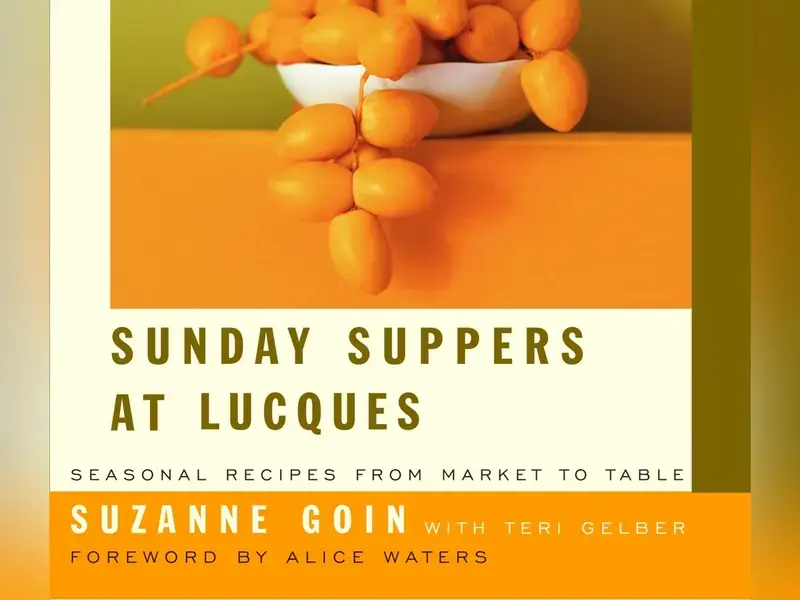
When it came time to write Sunday Suppers at Lucques, did you feel like you were responding to anything you thought was missing? How did you want it to be different from cookbooks that already existed?
It was not anything as strategic as trying to fill a gap. That would have been smart, but that wasn’t where my head was. Sunday Suppers was sort of the crystallization of Lucques. It was the part that almost meant the most to me. I just loved that special thing that we did at the restaurant, and it felt well suited for a cookbook because we could go through all the seasons. I wanted to build menus instead of having a compilation of recipes. I really wanted to give people direction on how you put those things together, and how a menu comes together, as opposed to just appetizers, salads, etc. I was doing it as much for myself as for the reader, because I think I just loved what we did on Sundays so much. I loved all parts of Lucques. I love cooking, and I loved Monday through Saturday too. But Sunday was the day when we always had a smaller staff. Each person had their own dish that you really focused on. So there was something very personal and special about cooking those Sunday Suppers. That was the part that I wanted to honor and share.
I loved Alice’s The Menu Cookbook from Chez Panisse, a book that meant a lot to me. I remember I felt like I learned a lot by reading it and seeing how she would put menus together, versus just going through a list of things and trying to figure out what matched. It was a way to guide people. For me, my brain definitely works in a seasonal way. I really like structure. I like going to the farmers market and knowing these are the ingredients I can get, and I can’t get anything else. I’m not going to call and get pineapples from Costa Rica. This is what I have, and I like those restrictions. Having restrictions for the book spoke to me. It gave an instant structure.
The book is divided into seasons, which was the essence of Lucques. At the time, did that feel like a new concept for cookbooks, especially for home cooks?
My book came out in the Rachel Ray era. The publisher was like, “What about people in other parts of the country? The seasonal thing doesn’t really make sense, and people aren’t going to cook that way, and nobody’s going to make a three-course menu.” They wanted it to be more of a traditional cookbook. And I was always like, “Well, they don’t have to make the whole menu. You can treat it however you want. If you’re just looking for a salad, you can go through and look for all the salads.” I didn’t want to make it generic. I wanted it to be very much about here and about me and about the farmers and about what I like to cook. And I think that’s always been a successful journey for me.
My most dreaded question this time of year is, “What are the food trends for 2026?” I don’t know, and I don’t care. I think if you start trying to give people what they want, or what you think they want, that is when you get something that doesn’t feel authentic and feels generic. So it was important for me.
That’s something you’ve always shared with me, that you’ve stayed true to yourself and trusted what felt right. You’ve alluded to the fact that writing, formatting, and styling Sunday Suppers at Lucques the way you wanted involved a fight. How did you win? How did you convince them to do it your way?
It’s funny because I can be very accommodating. Sometimes I’m a little bit of a people pleaser. But I think when I know that I want something, or when I know something is right, I’m like a dog with a bone. I’m not going to stop. My editor was great, and I had a really good agent, and I guess I convinced them. I was just like, “You know what? Yes, everybody wants to be able to do things easier, and there are plenty of books for 30-minute meals, so this book is not for those people. This book is for people who love to cook and who want to know more, and who want to make the food the way that we make it at the restaurant, or the way that I make it at home. And they’re going to be disappointed if I go through and take out a bunch of the details or steps to make it easier and faster. In the end, they’re going to be disappointed by the results. And that’s not really fair to anybody.”
Your cookbook really does that. You use so much detail in your instructions that it ensures a good result, which is what people want.
I think it made me a better teacher in the restaurants, having written the book, because there were so many things that I did intuitively that I didn’t even realize I was doing until I had to really write down what I was actually doing. My copy editor was really intense, and I am an intuitive cook. So for me, it was like, “Oh, until it’s done.” And they were saying, “No, no, no. We need you to explain exactly what it is you’re looking at when you’re noticing how you know it’s done, and how long it really takes,” and all that stuff. So that pushed me to hone those skills, which, in the end, helped me work with the cooks and train my staff in the restaurant.
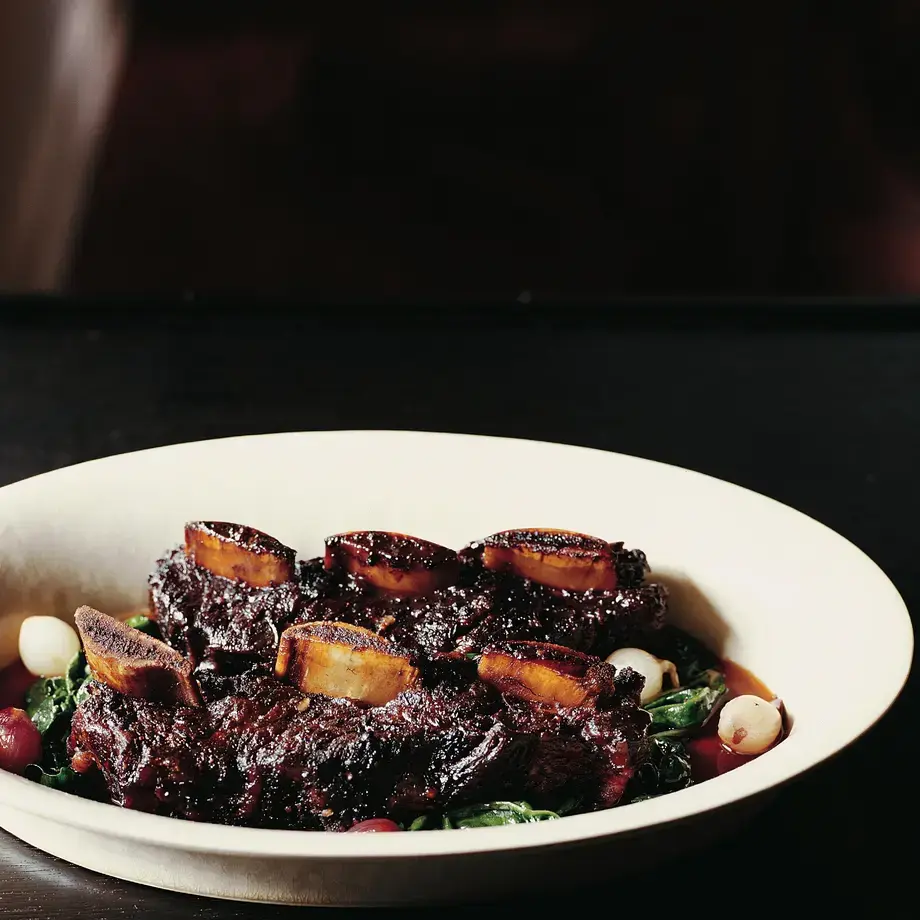
I have the book open to the braised beef short ribs on page 302, where you write, “Do not crowd the meat or get lazy or rush at this step. It will take at least 15 minutes.” A lot of recipes would just say “sear on all sides,” and now, whenever I’m braising anything that needs to be seared, I hear your words in my head telling me not to rush that step. The book teaches you lessons you carry with you.
I get the temptation, especially because I was testing at home. When you’re working in a restaurant, you have a bunch of different things going at once. So it feels like things sear really quickly, but that’s mostly because I’m probably chopping vegetables while the meat is searing behind me, and we also have more firepower. I remember being at home thinking, “Oh my god, this is taking forever, and if I think it’s taking forever, I’d better let people know, but it’s worth it.”
I think it is a book that a lot of people learn to cook from, and that was actually part of my goal. If I can teach you how to braise a short rib, then you can bring on the chicken thighs and the pork shoulders, or whatever else you want to do. You know the technique, and you can change the flavors and make it your own. I’m glad that I took the time to really spell it all out. I think one of the most rewarding parts of my career is that book and the sense of what it’s meant to people.
People really use your cookbook. After 20 years, I hear so many friends and colleagues describe their copies as well worn. As a restaurant chef, how did you think about bridging the gap to the home cook?
My cooking is not fancy or super technical. I mean, there’s technique, but I don’t rely on anything more than fire, pans, and wooden spoons. It’s not like there’s sous vide going on, or any of that type of stuff. The way that I cook in the restaurant is almost like I’m taking the soul of how I would cook at home and bringing that into the restaurant. I tested all the recipes at home to make them really home cook friendly.
I tried to bring the rigor of the restaurant, the expectation that you want it to be elevated, that you want it to be really special, and that you want layers of flavor, into home cooking. Those things are really just about loving food. It’s about coaxing the most out of every ingredient and thinking about textures and building flavors at home.
As someone who saw those menus come together week after week, I was always astounded that you were able to create new ones year after year. How did you choose which menus made it into the book?
It was actually really hard. It was a combination of trying to highlight the classics and the ones people really loved, things that I really loved, and also not repeating ingredients, which is the same thing that happens to me every season when I have to make a menu. It’s like, “Okay, where’s the pomegranate going this year? Because I can’t put pomegranate on four things.”
It was about trying to give the book balance, using all the ingredients I wanted to use without overusing them, and providing a mix of richer, heartier dishes and lighter, more refreshing ones. I also wanted to make sure I had enough fish, enough poultry, and enough beef. Luckily, I had years of menus to choose from, but narrowing it down was tough.
Do you anticipate writing more cookbooks, and if so, what would you want to do next?
I would love to. It’s funny, it’s like childbirth, you have to kind of forget how hard it was, and then you do it again. Just as we’re talking about it now, that would be the book I would want to write, another version of that same format, but with new recipes or old recipes too. I definitely have another whole book’s worth of menus and recipes.
I remember when I worked at Lucques, people from all over the country who were fans of the book would come in for dinner. Does that still happen?
It still happens. The thing about the book is, it exposes you to so many more people. I love when people bring in their really worn cookbooks. We had a bunch of different people who did Sunday Supper cooking clubs. I had one group of women from San Francisco, and they came down. They had made every recipe in the book, and they documented the whole thing. They had pictures of every recipe, everything they cooked.
The beauty of restaurants is being part of a community. You have the community of people who work there, the community of farmers and winemakers, and the community of customers. I feel like that book, in particular, has a whole community around it. And when somebody brings in their really worn, beat-up copy, it’s the best feeling ever.
Even after 20 years, this cookbook feels timeless.
I think good cooking is timeless. There are trends and ingredients that come and go, but I think in a time when everything’s so digitized, with your head in your phone, doing your own thing, being able to cook for yourself and your friends is something that really does bring us together. It brings me joy. I feel like it’s kind of what life’s all about.