Well, I hate to say I told you so. (Who am I kidding? I love it.)
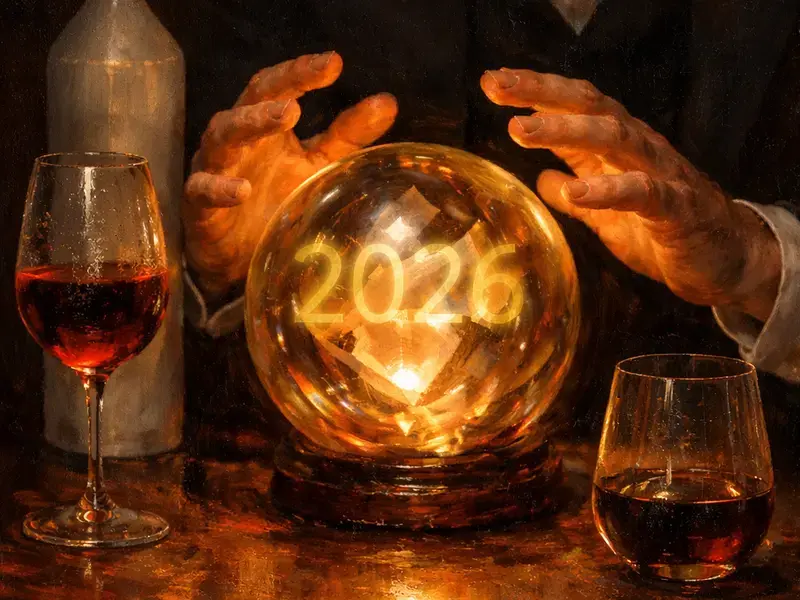
Last year, I gazed into my crystal wine glass and made a few bold predictions about the state of the wine world in 2025. Looking back, I was uncomfortably accurate. I predicted that white wine would finally eclipse red in popularity, which it unequivocally did, driven, at least in part, by our desire for refreshment in a warming world. I also said the Non-Alcoholic (NA) wine market would explode, and lo and behold, its valuation grew by over 10% this year.
But I’ll be the first to admit I didn’t get everything right. I predicted a “slight dip” in wine consumption, an optimistic little oversight that turned out to be a structural nosedive. Between the Surgeon General putting a skull and crossbones on Merlot and Gen Z deciding they’d rather drink mushroom water, the decline was steeper than advertised.
So, lesson learned: no more sugar-coating. The wine world of 2026 is entering a “new volatile equilibrium.” It’s going to be a year defined by political headwinds, weird packaging, and a desperate search for affordable acid.
Here is what you’ll be drinking, and how much you’ll be paying for it, in 2026.
1. The Tariff Hangover Is Real
If last year’s inflation was the “uninvited party guest eating all your snacks,” wait until you meet its manic, sadistic cousin: tariffs. (Quick, cover the punch bowl.)
With the second Trump term officially ushering in a new era of protectionist trade policy, 2026 is shaping up to be the “Year of the Tariff,” with potential levies of 15% to 30% on European wines. And because of the brutal math of the three-tier system (importer to wholesaler to retailer), a 25% tariff doesn’t mean a 25% bump for consumers; it could cause retail pricing increases of 50% or more. That $30 bottle of village-level Burgundy you love could be $45 by summer.
I’m predicting a false peak in the early months of the year, as importers panic-buy and front-load inventory to beat the implementation dates. So if you see a bottle of French wine you like in January, buy a case (or nine). Q2 is going to be a hollow season of high prices and scarce European juice.
2. The “Sancerre Solution”
Speaking of French wine we can’t afford: Sancerre has officially become the “Rolex” of white wine—highly desirable, flashy, and completely unobtainable for the average Tuesday night drinker. Between consecutive short harvests and insatiable demand, the price has skyrocketed.
But wine drinkers are creatures of habit, and they crave that “gunflint” and “chalky” zest. I predict that in 2026, savvy somms and retailers will pivot aggressively to the “satellite” appellations of the Loire Valley.
Look for Menetou-Salon, Quincy, and Reuilly. These regions sit on the exact same Kimmeridgian limestone (ancient seabed fossils, for you non-geology nerds) as Sancerre. They taste nearly identical (zesty, mineral-driven, crisp), but because they don’t have the famous brand name, they only cost about two-thirds of what Sancerre will run you ($15 versus $25). It’s the ultimate economic arbitrage for your palate.
3. Red Wine Finally Chillaxes
For years, “chillable red” was a niche hipster trend, something you’d only find at a natural wine bar where the furniture is made of milk crates, your server’s name is Apple, and the wines are described as emotional states. In 2026, chillable reds go mainstream.
The decline of red wine consumption wasn’t a rejection of red grapes; it was a rejection of warm, tannic, high-alcohol sludge. In a warming world, consumers want refreshment, not a heavy blanket.
Soon, with the “room temperature” service standard declared DOA, expect to see a massive influx of “Bistro Reds,” or vin de soif (wines of thirst), wines specifically for the fridge. We’re talking Frappato from Sicily (which, incidentally, tastes like strawberries and roses), Gamay from Oregon, and even Zweigelt from Austria. These wines are low-tannin, high-acid, and hover around 11–12% ABV.
If you’re drinking a red wine in July and it isn’t sweating condensation, you’re doing it wrong.
4. The Paper Bottle Revolution
I know, I know: you like the clink. There is romance in glass. But glass is also heavy, fragile, and responsible for the vast majority of wine’s carbon footprint.
I declare that 2026 will be the year the “Frugal Bottle” moves from novelty item to retail staple. These aren’t the soggy juice boxes of your childhood; they are rigid cardboard shells with a bag-in-box liner that have a carbon footprint 84% lower than glass. Major retailers like Target are already stocking them.
It’s not just for cheap plonk, either. I believe more established brands and wineries will shift entirely to alternative packaging for wines meant to be consumed young. After all, if you’re going to drink a wine within 48 hours of buying it (the way most wine is meant to be consumed), why would you need a glass sarcophagus that will outlive your grandkids?
5. High-Tech Sobriety
While I mentioned in last year’s round-up of future trends that “Non-Alcoholic Wine Will Be Even More of a Thing,” the NA sector is undergoing a technological and cultural renaissance I admittedly didn’t see coming.
Though the “Dry January” crowd was once punished with unfermented grape juice that tasted like a lonely childhood, the days of 0.0% ABV wines are being challenged by the rise of 0.5%, or “dealcoholized,” juice, as producers and consumers realize that trace amounts of alcohol are essential for preserving flavor and aromatics. Using vacuum distillation and spinning cone columns, producers can now remove alcohol at low temperatures while preserving the volatile aromas that make wine taste like wine.
Even more interesting is the “functional” turn. The “sober curious” movement is evolving with those who don’t just want the absence of alcohol; they want the presence of chill. Expect to see NA wines infused with adaptogens like ashwagandha, L-theanine, and valerian root. These drinks promise to replicate the “unwinding” ritual of a glass of Merlot without the hangover. It’s the buzz without the booze (but most often, without the elegance and complexity of flavor, too).
6. The “Barbell” Economy
Finally, the wine market is shaping into a barbell. The middle class of wine (think $15 to $18) is hollowing out. Inflation and “drinkflation” (where quality degrades to keep prices stable) have made the $15 bottle a minefield of mediocrity.
Consumers are splitting: you’re either trading down to private-label wines and Tetrapaks for Tuesday night, or you’re trading up to the $30+ bracket to guarantee quality.
So, welcome to 2026. The bottles are made of paper, the reds are cold, and the “wine” might not even get you drunk. It’s a brave new world. Drink accordingly.