Once, an acquaintance told Julia Child about Julie Powell’s project—the one that eventually became Julie & Julia—in which the author cooked her way through all 524 recipes in Mastering the Art of French Cooking over the span of a year. When the storied chef read Powell’s blog, which candidly recounted the struggle of working all day and then tackling highly involved recipes each night, Child was unimpressed. “Well,” she said, “she just doesn’t seem very serious, does she?”
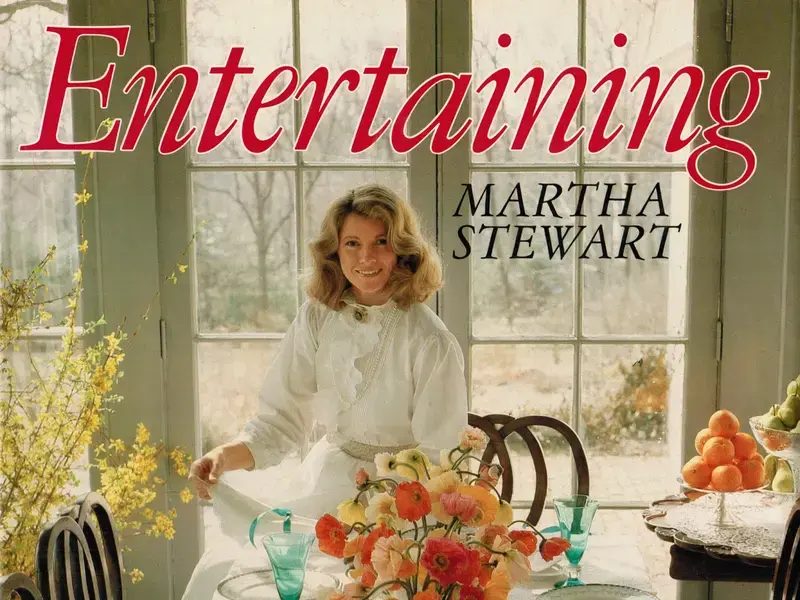
That bone-chilling response went through my mind as I paged through Entertaining, Martha Stewart’s 1982 debut cookbook. The collection of more than 300 recipes, plus advice on hosting and decorating, is as beautiful and inspiring today as it was more than 40 years ago—and it established her as a homemaking guru and the “original fucking tradwife.” Beautiful and inspiring, yes, but also completely intimidating, not unlike Stewart herself.
The book is organized by event, with menus like “Summer Omelette Brunch Outdoors for Sixty” and “Sit-Down Country Luncheon for One Hundred Seventy-Five.” For Christmas, Stewart recommends building your own “gingerbread mansion” (there are step-by-step photos) and preserving fruit harvested at peak season for holiday gifts: strawberries are best in rum, she says, and raspberries in kirsch. And should you ever find yourself hosting an “at home wedding,” there is a whole chapter devoted to that, complete with a breakdown of how to bake and decorate a four-tier wedding cake.
On perusing possible Entertaining recipes to try, my gut reaction was not unlike Powell’s on first reading Child’s cookbook: I know I can do this, but it’s going to be so. hard. I could imagine Martha’s response, too, which would probably be something like, Well, are you serious or not?
Despite having published more than 100 additional (and generally easier-to-follow) books since, Stewart’s Entertaining has remained among her most sought-after works, with first editions selling for something like $600 on eBay. The cookbook—and Martha’s—enduring popularity is why she reissued it in October 2025, otherwise untouched save for a note about “words or phrases that are no longer in use.”
The book is, as they say, “of a time.” In that time, women were still primarily expected to be homemakers who could whip up a 60-serving batch of smoked trout mousse or eight quarts of tarragon chicken salad (both actual yields for recipes in the “Cocktails for Two Hundred: Country Fare” section). Regardless of whether they held jobs outside the home, their primary responsibility was not just executing a home culinary program that aspired to be like Martha’s, but making it look effortless.
In Entertaining’s 310 pages, there is not a single acknowledgment that anything inside might be daunting; the closest we get is the line “planning can be time consuming,” followed by a five-day cooking schedule for a 175-person wedding luncheon.
That Martha made it look so easy, and that she still makes it look so easy, even at 84, is part of what makes her and her lifestyle brand so appealing. In the years since, the illusion of effortlessness has fallen out of favor. Lifestyle influencers who appear to deflect exhaustion and the realities of work–life balance are now, more often than not, vilified for it (see: Gwyneth Paltrow and Goop), while figures like Ina Garten—who will happily encourage you to buy a store-bought pie crust—have oversized cosmopolitans raised in their honor.
Martha will not encourage you to serve your guests anything premade, unless you made it yourself in advance. Recently, I took a cooking class at The Bedford by Martha Stewart, the restaurant inspired by her upstate New York farmhouse. We were making Big Martha’s pierogis, her mother’s recipe, and Stewart herself was there (the classes are offered weekly but are taught by Bedford chefs, not Martha).
As Stewart came around to review our work, a woman next to me asked if she had any tips for the upcoming holidays. Order the meats from your butcher early, Stewart said, and prep your pies in advance. The woman clarified that she meant time-saving tips. “No,” Stewart said, leveling a deliciously Marthaesque gaze in her direction. “I don’t do shortcuts.”
Maybe it’s my generational conditioning, or maybe it’s that I grew up on binges of The French Chef, but I will absolutely break myself in half for a dose of the praise that comes from the illusion of effortlessness. Three days of cooking and cleaning for a three-hour dinner party? I’ve done it a hundred times, and I’ll do it a hundred more, including for New Year’s Eve this past year, when I happily prepared my own birthday feast. It hits the exact same dopamine receptors as when Martha looked at my work during that class and called my pierogis “perfect.” (I will be dining out on that moment for the rest of my life.)
Of course I pored over Entertaining while compiling a menu. Of course it took work, and to put a finer point on it, effort. None of that mattered once my friends and I sat down to eat. All that mattered was that we were having a shared experience, walking away with not just leftovers, but memories to savor. Well, that, and that someone else did the dishes.