Sorry, you need to enable JavaScript to visit this website.
Miles Thompson's Bookshelf

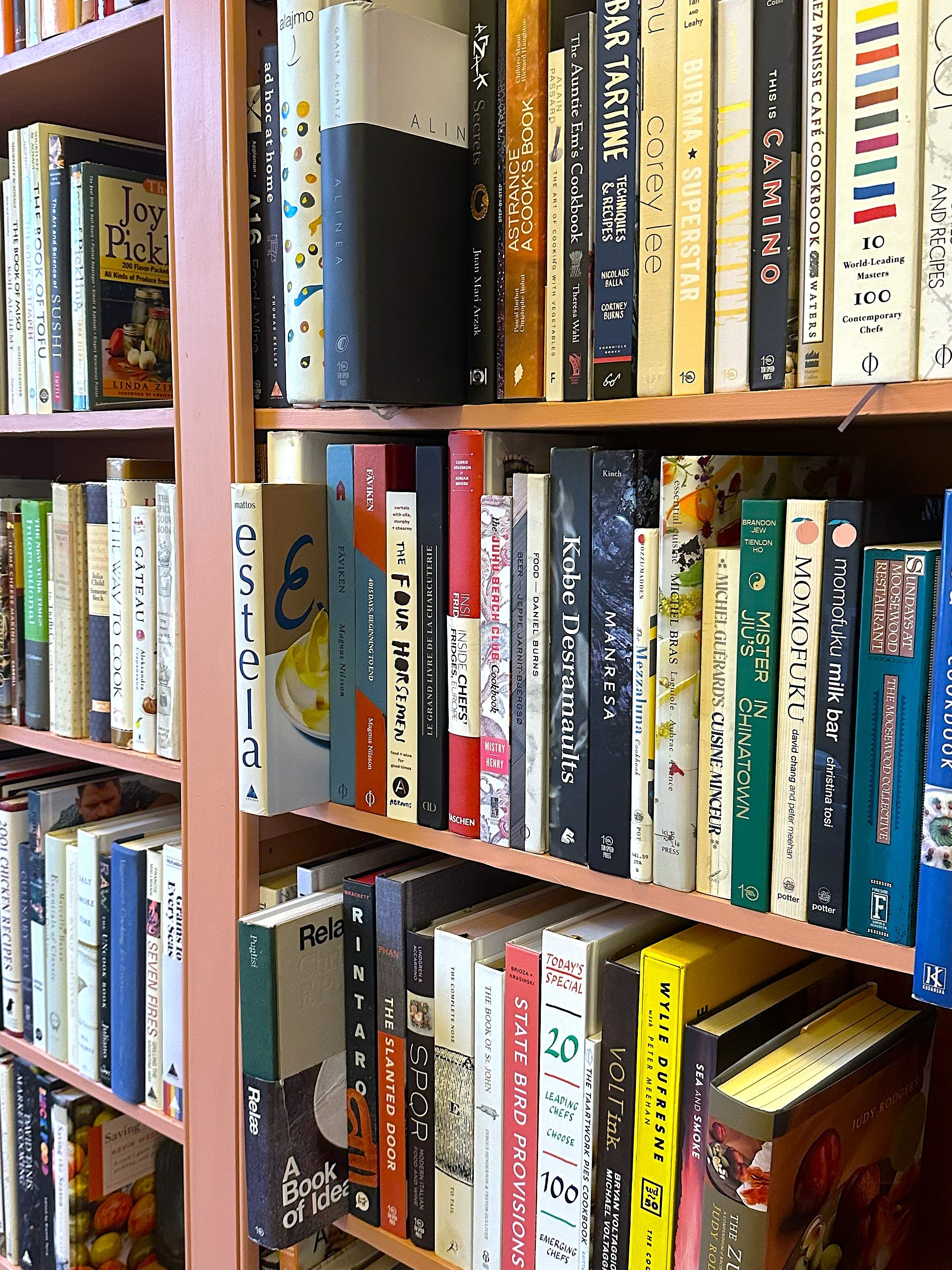
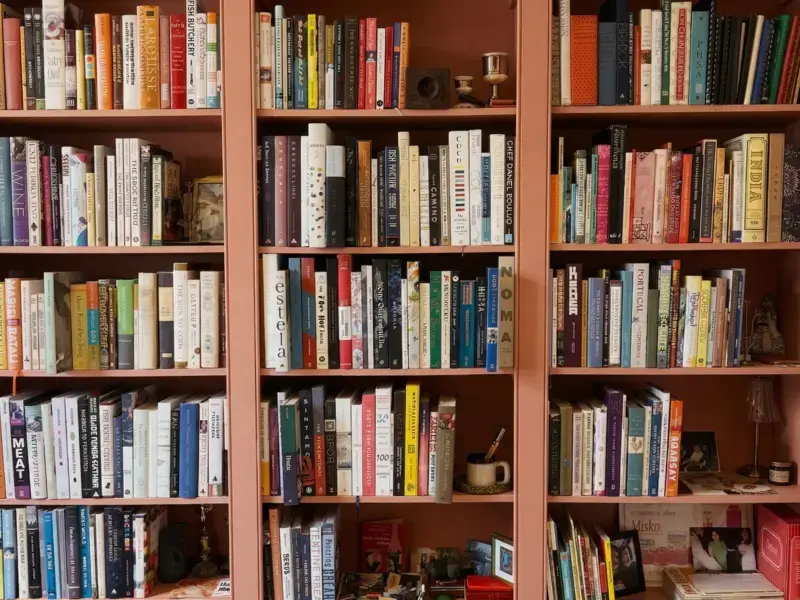
Miles Thompson's Bookshelf. Credit: Darin Bresnitz

The Cookbooks That Made Miles Thompson

14 Minute read

A look inside the Baby Bistro chef’s 300-plus cookbook collection and how it shaped his path from early curiosity to a fully formed culinary voice.

Miles Thompson’s cookbook collection is impossible to ignore. More than three hundred volumes line custom, twelve-foot shelves built by his wife and father-in-law, their worn spines and softened pages revealing years of use. His treatises show a lived-in patina, set within coral-colored framing, books that open instinctively to recipes he has returned to again and again.

This is not a collection assembled for display. It is a working archive of how he learned to cook.

For Thompson, these books came long before authority in a kitchen. They offered access to ideas, techniques, and lived experience that extended beyond his immediate surroundings, shaping his instincts as much as any restaurant job. Miles’s partiality to the physical nature of his collected works ties to the tactile nature of his passion.

“These books mean a lifetime of curiosity,” Miles explains, “but with answers.”

That idea carries through everything he returns to on his shelves, not just what he learns, but how he learns. The books are not static references. They are active, revisited, and constantly reinterpreted.

“I love the smell of a library. I love the smell of old books. There's a spark of curiosity when I open a new book,” Miles says. “It's like, what am I going to find? The Zuni Café Cookbook is one of my favorites of all time. I remember reading about how one of her chefs would salt the fish at the end of the night because it would season it for the next day. And as a young cook, I didn’t think about those kinds of things. So, the lived experience of a lot of these chefs and writers is what is inspiring to me.”
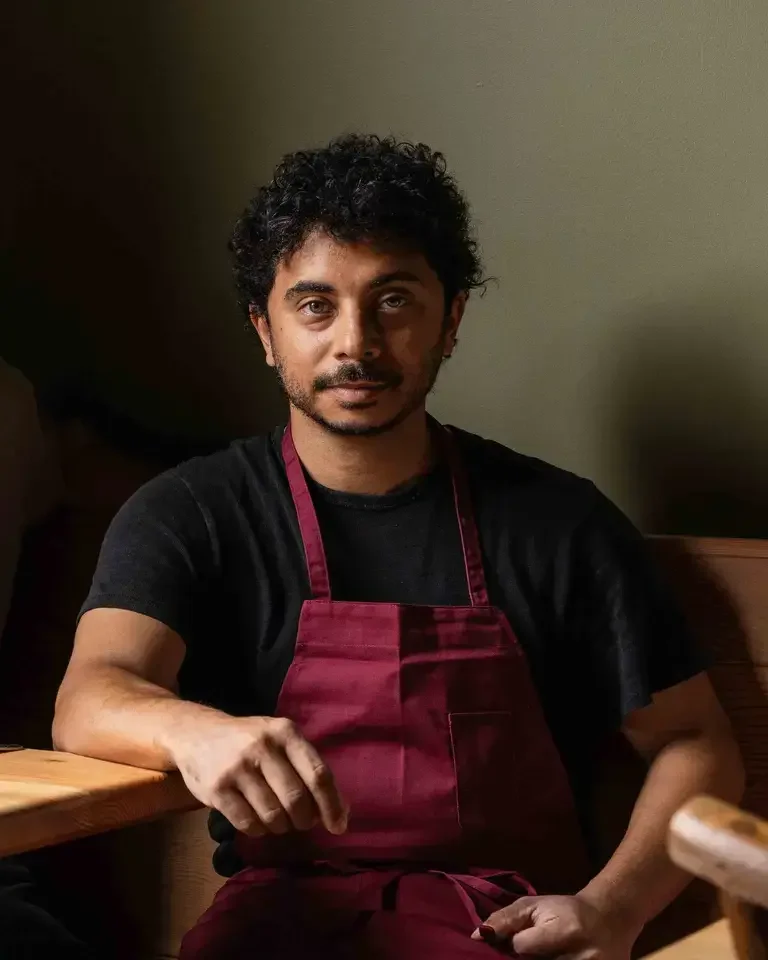
Miles Thompson and His Books

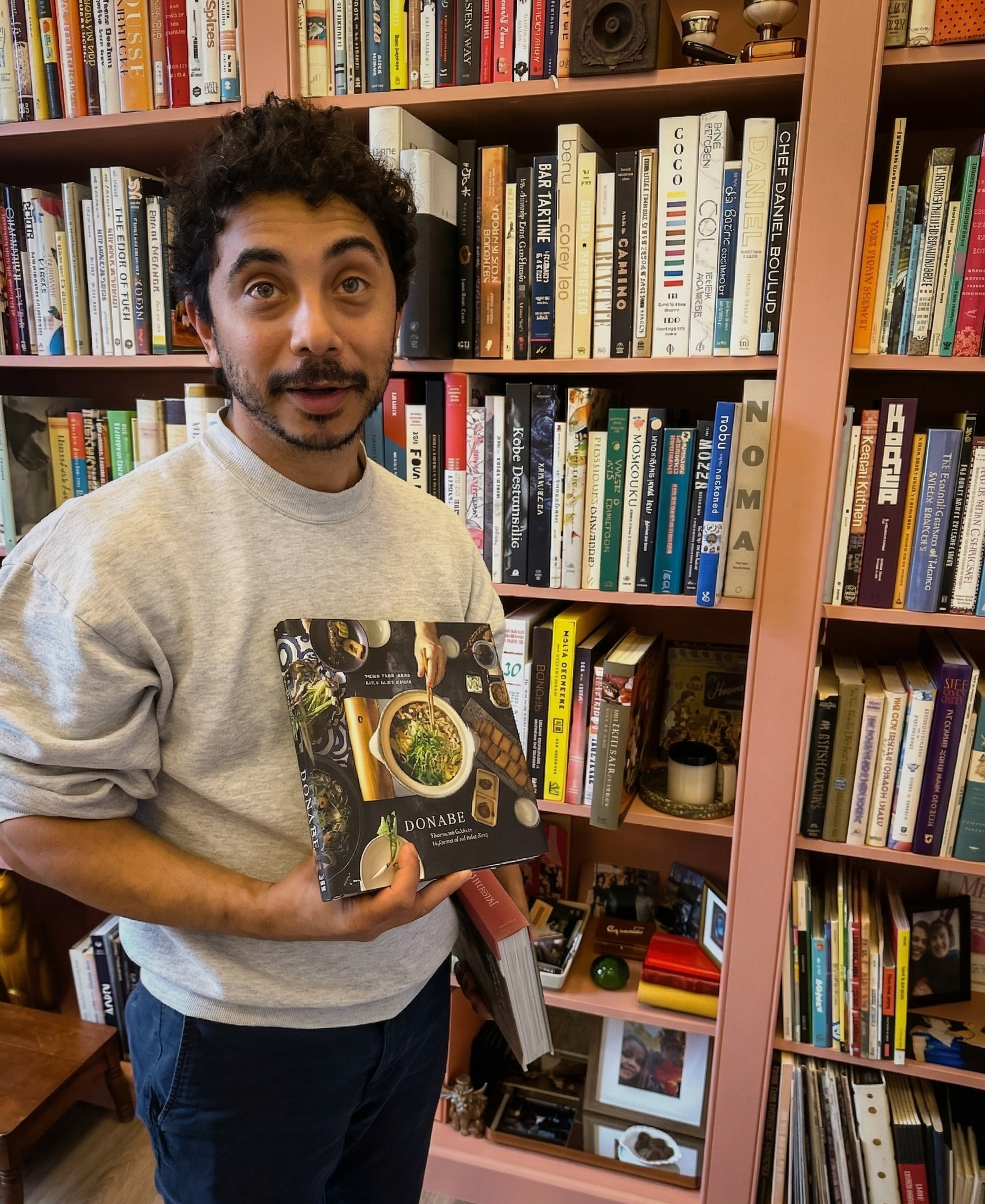
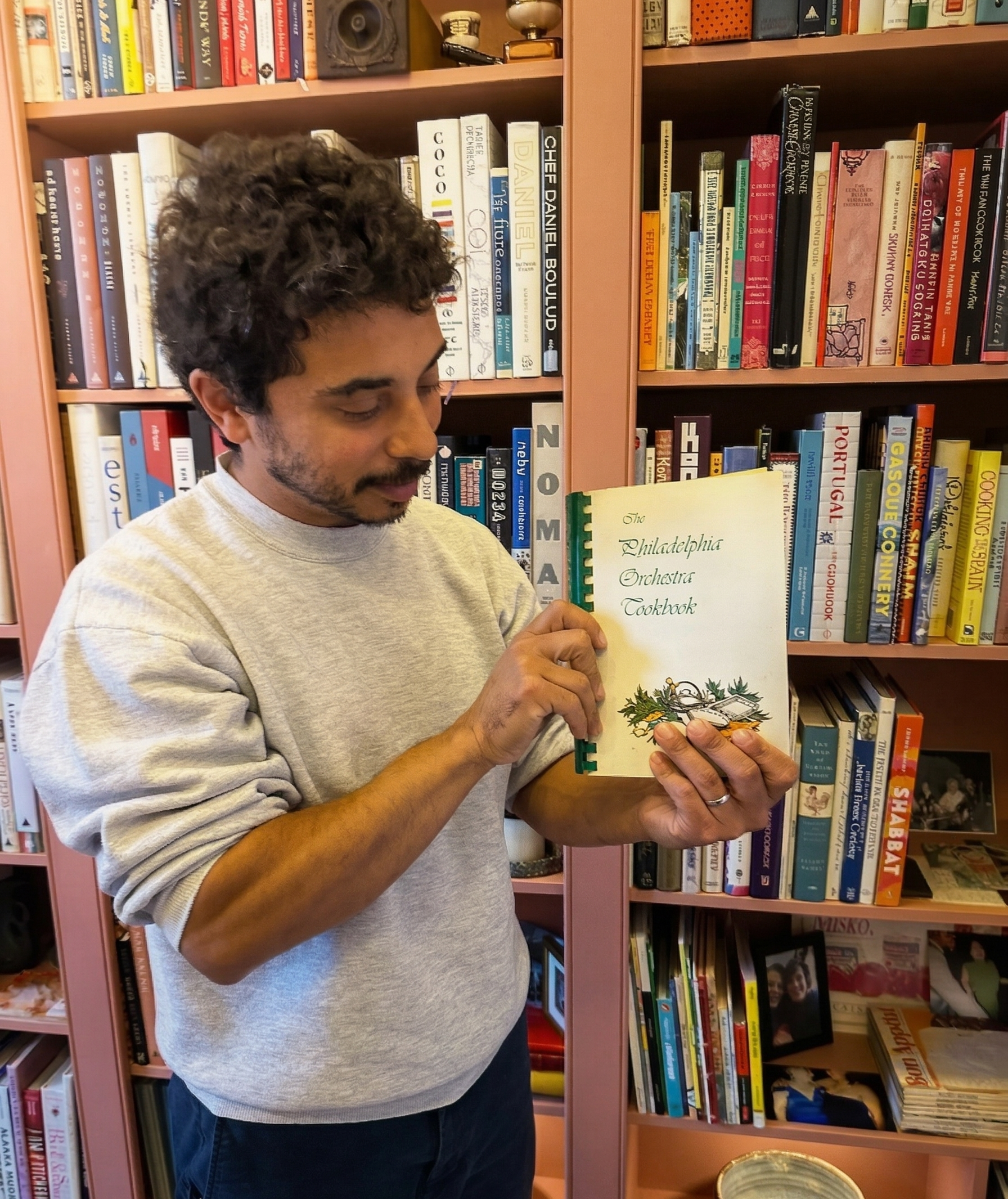
Miles Thompson and His Books. Credit: Darin Bresnitz

The First Obsession

Long before Miles Thompson was cooking professionally, he was already learning through books.

“The first book I ever bought was [Nobu: The Cookbook] from Costco,” he says. “I remember seeing their stuffed squid dish, and just thinking that’s the craziest thing I’ve ever seen. It’s squid with black rice inside of it. I didn’t grow up eating food like that.”

That early fascination stayed with him long enough to come full circle. When he eventually found himself working at Nobu, the dishes he had once studied began to take on new meaning.

“I remember reading about the eel, and the nitsume, the sauce for the eel,” he says. “One of the first days I was in the back part of the kitchen at Nobu, there was this huge cauldron of boiling eel sauce right there. I was like, ‘That’s so crazy. How do they make that?’”

He learned quickly. Butchering eels, making nitsume, and executing the same preparations he had first encountered on the page, Thompson began to understand the gap between reading about food and actually making it. The book sparked the curiosity. The kitchen gave it form.

That curiosity deepened under Nobu chef Alex Becker, who recognized Miles’s drive and handed him a copy of In.gredienti by Massimiliano and Raffaele Alajmo.

“‘What is this? I’ve never ever seen this book.’ That was a book that absolutely inspired me. I read it through and through in like a week. That book was on a creative level so mind-blowing and expensive.”

Around that same period, he also found Alinea by Grant Achatz, whose rigor, precision, and artistry offered a different kind of revelation. Together, the two books expanded his sense of what cooking could be, shifting his focus from replication to invention.

Miles Thompson and His Books

Miles Thompson and His Books. Credit: Darin Bresnitz

Learning to Cook, Learning to Think

If In.gredienti and Alinea expanded Thompson’s sense of possibility, the next phase of his education pushed him to grasp something more fundamental: how to actually cook.

That shift took shape through books like Cooking by Hand by Paul Bertolli, which he encountered through Daniel Gallo, then a sous chef at Animal in Los Angeles, where Miles had landed on the line.

“I hadn’t heard of it,” he says. “When I got it, it was the most analog book I’d read.”

What struck him was not just the recipes, but the mentality behind them, one rooted in patience, repetition, and craft.

“There are recipes about making salumi in that book, how to test it, all this kind of stuff that you need,” he says. “Making beautiful pastas with whole grains, Italian cooking, but through the lens of California wine country.”

The influence was immediate. Where earlier books had pushed him toward creativity, Cooking by Hand grounded him in the physical realities of cooking, working with ingredients at their source, understanding texture, timing, and restraint.

That same mindset extended into the broader California lineage he was beginning to understand. Restaurants like Bertolli’s Oliveto, and its cooking, emphasized seasonality not as a concept, but as a practice, with menus shaped by what was available, not what was imagined.

“They had this huge spit, and would do whole lamb dinners,” he says. “A tomato menu every year, twelve courses, everything with tomato, desserts, green tomato, all these variations.”

By the time Thompson began developing dishes of his own, that philosophy had already taken hold. The market was not just a source of ingredients. It was a guiding muse.

Miles Thompson's Bookshelf

Miles Thompson's Bookshelf. Credit: Darin Bresnitz

Toward Simplicity

From there, the trajectory becomes less about accumulation and more about refinement. The lessons of The Zuni Café Cookbook by Judy Rodgers and Chez Panisse Café Cookbook by Alice Waters reinforced a different kind of discipline, one rooted in restraint.

“Seasoning a salad is the single hardest thing that you can do as a cook,” he says. “If you can make a perfect salad, I will hire you immediately.”

And then, finally, everything converged.

In Spain, at La Cova Fumada, he ate a dish that clarified the type of cooking he had been chasing for his career.

“Squid cooked on the plancha with garlic, parsley, and olive oil,” he says. “The squid is coming right out of the ocean that morning. So clean. So perfect.”

It was a moment that echoed the philosophy he had been circling for years, one grounded not in excess, but in reverence.

If there was a single book that crystallized that idea, it was The Complete Nose to Tail: A Kind of British Cooking by Fergus Henderson, whose approach to ingredients reinforced a belief Thompson had been building toward all along.

“The idea of ingredient reverie was already there,” he says. “I wanted to figure out a way to honor ingredients in a way that I don’t think I ever really had before.”

That clarity carries into his new Los Angeles restaurant Baby Bistro. Co-founded by beverage director Andy Schwartz, Thompson’s cooking reflects a balance he spent years working toward. It is neither purely technical nor purely rustic, but something more deliberate, shaped by repetition, curiosity, and intention.

Part of that thinking is visual. As he developed the restaurant, Thompson looked to Estela by Ignacio Mattos as a point of reference, not for replication, but for perspective.

“No one cooks like Ignacio Mattos,” he says. “It’s surreal, honestly. His plating style is so singular.”

What stayed with him was not a specific dish, but a philosophy. The food did not rely on perfection or precision for its own sake. It carried a physicality, larger gestures, clearer forms, compositions that felt intentional without becoming ornamental.

“I didn’t want the food there to look like the food you see on Instagram,” he says. “It had to have a rusticity, but a precision at the same time.”

That balance, between control and instinct, is the throughline that connects the books on his shelves to the plates leaving his kitchen. The influences remain, but they no longer feel like references. They feel absorbed into his own voice.

Asked whether he ever imagines adding his own book to the collection, Thompson does not hesitate.

“We all have a story, and I want to tell the story of how I learned to cook,” he says. “How these books, like my chefs, and myself, taught me how to cook.”

When it arrives, it will not simply be a collection of recipes. It will sit alongside the others as part of the same ongoing conversation, one shaped by curiosity, experience, and the search for something that can only be learned over time.

Spread the flavor - share this story.

Join the community
Badge
Join us for unlimited access to the very best of Fine Dining Lovers
Unlock all our articles
Badge
Continue reading and access all our exclusive stories by registering now.

Already a member? LOG IN