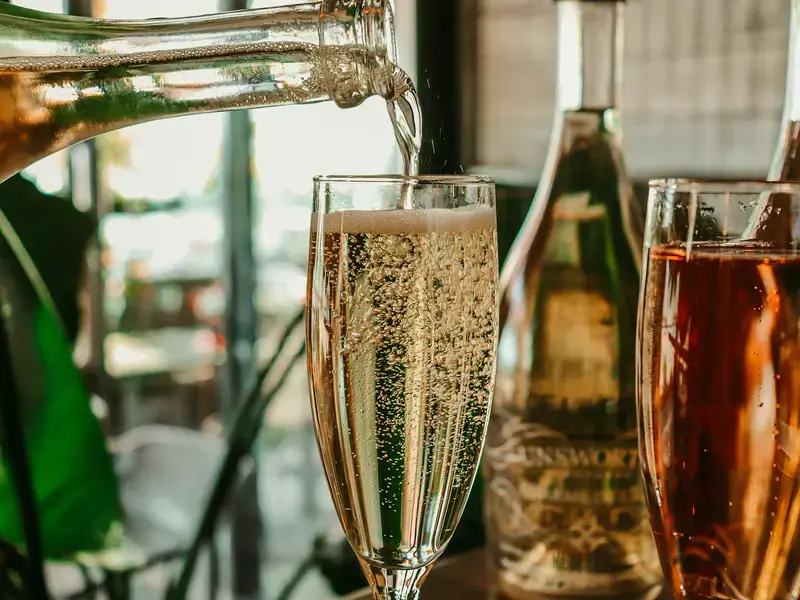
Plunking down a bottle of big-house Champagne on the dinner table doesn’t carry the same swagger that it used to. Defaulting to a recognizable corporate label has become the vinous equivalent of playing hotel lobby jazz at a cocktail party: it’s safe, predictable, and dull.
These days, if you really want to electrify a meal and perhaps show off just a bit, you need two things: an oversized 1.5-liter bottle and a label hailing from the chalky hills of southern England.
English sparkling wine has officially graduated from a plucky viticultural underdog to an international powerhouse. At the 2026 Decanter World Wine Awards, the world’s largest wine competition, English bottles swept up top honors, including Balfour snagging a Best in Show award for its 2018 Blanc de Blancs magnum. But while wine geeks have spent years arguing about soil parallels between the Paris Basin and the South Downs, chefs and sommeliers have fallen in love with English fizz for a much more visceral reason: it might just be the greatest high-fat food foil on earth.
And when you bottle it in a magnum, it transforms from a refreshing aperitif into an all-night dining centerpiece.
The Physics of the Big Pour
Why the obsession with the 1.5-liter format? It’s not just theatrical showmanship (though the oversized vessel undoubtedly sets a celebratory mood): there’s real chemistry happening within. A magnum holds twice the volume of wine as a standard 750-milliliter bottle, but its neck and closure are typically similar in size.
“Magnums develop more slowly because there is proportionally less oxygen relative to the volume of wine,” explains Fergus Elias, head winemaker at Balfour. “The fruit, acidity, mousse, and savory characters often seem to come together particularly well. You retain the precision and tension, but the wine develops additional breadth and calmness around it.”
For cool-climate English wines, where naturally soaring, laser-focused acidity forms the spine of the cuvée, that slower evolution is magic. It gives the liquid the runway it needs to build deep, brioche-laden richness from aging on spent yeast without sacrificing an ounce of energetic freshness.
“The mousse in magnums can be finer, which leads to a creamier feel on the palate,” notes Laura Rhys, a Master Sommelier and head of wine at Gusbourne, one of the most awarded English wine producers. “Our magnums hold their precise and fresh fruit characters for longer, yet as they age they develop more intense tertiary notes and complexity.”
Perfect Pairings
But of course, the primary reason to bring an English magnum to dinner isn’t to dissect its yeast autolysis notes; it’s to eat with it.
Thanks to England’s cooler growing season, its sparkling wines boast a linear, razor-sharp acid profile. Pair that with moderate alcohol and chalky minerality, and you have a liquid laser that can slice through saturated fat, butter, grease, and rich sauces with stunning efficiency.
Having blind-tasted the world’s elite sparkling wines across Decanter panels, Master Sommelier Stefan Neumann, a regional chair at the Decanter World Wine Awards, stresses that England’s critical acclaim is driven by balance rather than just crispness. “The gap between England and the established sparkling regions is becoming much more about stylistic differences than quality differences,” says Neumann.
That stylistic difference pays massive dividends at the table. When compared to Champagne, English sparkling offers “a very particular combination of ripe fruit, naturally high acidity, and a distinctly linear structure,” says Elias. “With something like a buttery lobster roll, the acidity cuts through the richness while the lees character works with the bread and butter.”
Rhys takes it a step further, using English sparkling to replace heavy red wines alongside red meat. “Gusbourne Blanc de Noirs in magnum is the perfect match for steak,” says Rhys. “The acidity allows it to stand up to and cut through a richly marbled steak, where the acid essentially does the same job that tannins usually would.”
High-low pairings are equally viable. For example, Rhys and Neumann both single out crisp, hot fried chicken as the ultimate pairing for English Blanc de Blancs. The searing citrus and chalky salinity rip right through the fried coating while complementing its seasoned crunch.
Neumann also points to Blanc de Noirs or Pinot Noir-dominant sparkling blends for decadent comfort foods like crispy roast pork belly or a greasy, double-patty cheeseburger.
But if budget is no constraint, Neumann offers a dream menu: “Take Hambledon Classic Cuvée out of magnum, find the finest Scottish salmon, slightly smoked, and slap a bit of caviar on it. Close your eyes, focus on the purity and texture, and then you are allowed to cry, either because your senses are overwhelmed with joy, or from the negative balance of your bank account.”
On elite tasting menus, English fizz can also help solve an old sommelier headache: palate fatigue.
“In a restaurant, and particularly with tasting menus, it offers the opportunity to serve this wonderful, refreshing glass in the middle of the menu, rather than feeling the need to make every subsequent glass bigger, richer, and more powerful,” says Neumann.
Instead of marching diners through an escalating gauntlet of oaky Chardonnays, funky skin-contact whites, and palate-numbing Cabernets, dropping a cool, mineral-drenched pour of English bubbles right before the main course can refresh the diner’s palate.
The Host’s Secret Weapon
Lastly, there’s practical hosting math to consider.
“As soon as there are more than four of you, a normal bottle gives everyone one and a half glasses,” Neumann points out. A magnum doesn’t just eliminate the indignity of rationing out pours; it allows everyone at the table to watch the wine breathe, warm slightly, and evolve in the glass over two hours of eating.
“Big-house Champagne will always have its place, but choosing something purely because everybody recognizes the label is perhaps becoming a slightly less interesting way to buy wine,” says Elias. “A magnum says that the host has chosen something because of where it comes from, how it was made, and how it will work at the table.”
And when you have a table covered in fried bird, rich shellfish, or marbled beef, that bright, electric English style in a giant bottle is impossible to beat.