1. Stir, Stir, and Stir Again
Constant whisking is your secret weapon. Start by melting the butter, then stir in the flour to form a roux. As you gradually add milk, keep that whisk moving—especially around the edges and base of the pan, where sauces like to stick and burn.
Chef Tip: Use a balloon whisk for best results. Its wide loops reach every corner of the pan and keep your sauce silky-smooth.
2. Go Easy on the Heat
Low and slow wins the race. High heat risks burning the roux or causing the sauce to split (when milk proteins curdle).
Chef's tip: Begin with low heat for the roux, then gently increase to medium as you whisk in the milk. Patience makes perfection.
3. Use Quality Ingredients
A sauce is only as good as its building blocks. Opt for whole milk for richness and European-style butter with higher butterfat for flavor.
Chef Tip: If you’re watching the calories, you can substitute semi-skimmed milk, but don’t be tempted to use low-fat butter substitutes, as fat is necessary for making the roux.
4. Get the Flour-to-Butter Ratio Right
The golden rule? Equal parts butter and flour by weight. Too much flour = lumpy. Too much butter = runny.
Chef Tip: Don’t eyeball it - 2oz of flour looks nothing like 2oz of butter. Use a kitchen scale for precision. When adding milk, adjust the amount to achieve the desired thickness of the sauce, while maintaining the constant ratio of flour to butter.
5. Cut Butter into Cubes
If you drop in a big lump of butter, the bottom can scorch before the top melts. Cutting it into cubes helps it melt evenly.
Pro Tip: This also speeds things up - less waiting for butter to melt means you’re whisking sooner.
6. Get Your Timing Right
A proper béchamel starts with a white (blond) roux - cooked just long enough to lose its raw flour taste but not so long that it browns.
How to know it’s ready: After 3–5 minutes, it should have a distinct cookie dough aroma. Taste it—if it still tastes floury, keep cooking. If it doesn't, you're ready to start adding milk.
Pro Tip: brown roux can be used to make other sauces, but it’s not the flavor we’re going for here, and it won’t thicken the sauce so well.
7. Warm Your Milk First
Cold milk hitting hot roux = spitting, clumping, and frustration. Warming it makes the process smoother and faster.
Pro Tip: Heat milk in the microwave for 2 minutes or in a pan until just warm.
8. Add the Milk Slowly
If you add the milk all at once, the roux will clump together in little lumps at the bottom of the pan, and it will be challenging to whisk them all out. The trick is to pour the milk in a little at a time, whisking the mixture as smoothly as possible before adding the next drop.
Pro Tip: Think of it like making risotto—gradual additions create the best texture.
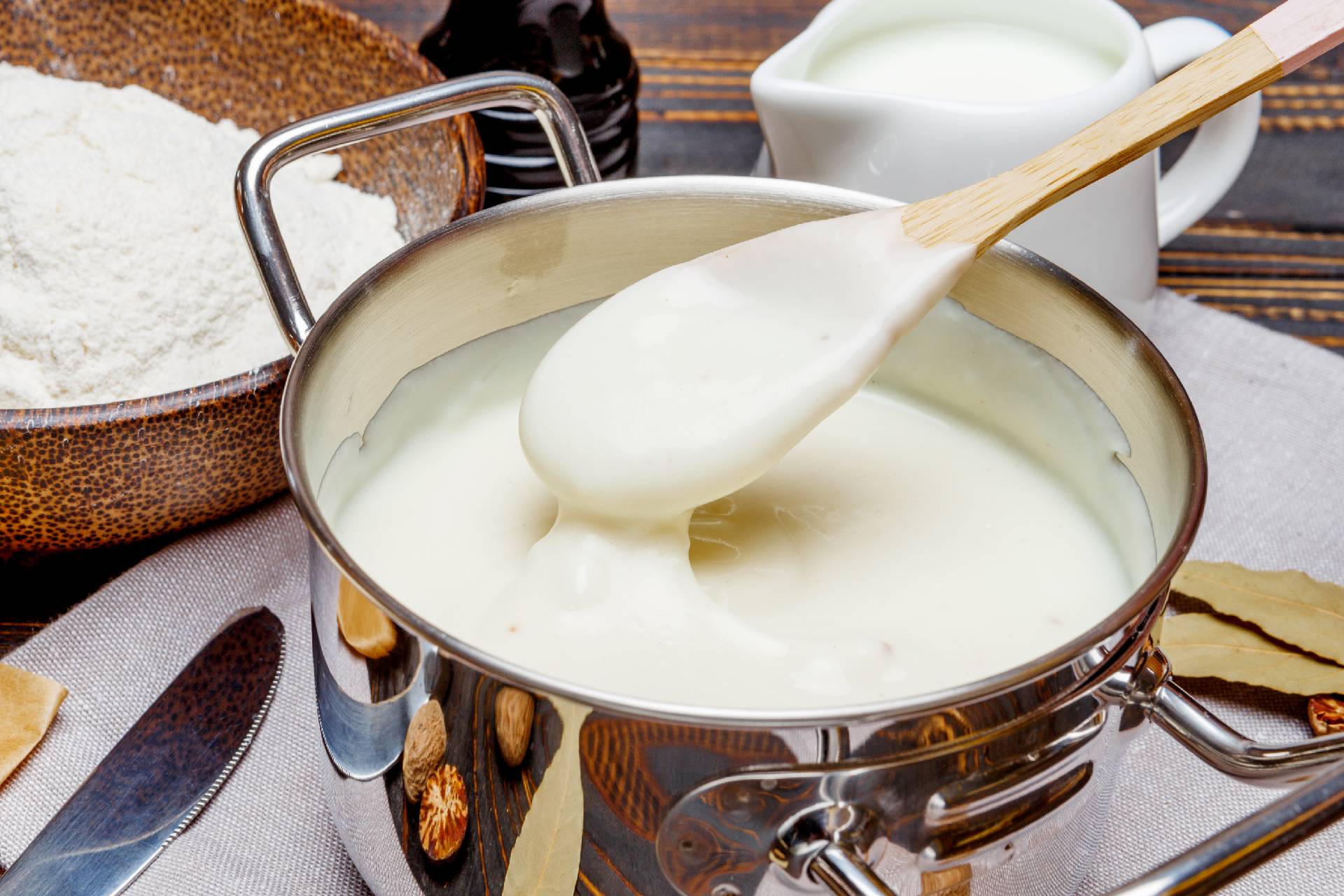
9. Cook Until It Coats a Spoon
A béchamel is done when it clings to the back of a spoon. Drag your finger through it - if it leaves a clear line, you’re good to go.
Pro Tip: If it runs back together, give it a little more time. Don’t rush!
10. Make It for Everyone
Some of the ingredients in regular béchamel sauce may not be suitable for everyone. Coeliacs and people with gluten intolerance can’t eat flour, while milk and butter are not suitable for vegans. Fortunately, there are substitutes for all three of these ingredients, allowing you to create a béchamel sauce that everyone can enjoy.
Gluten-free: Use a mix of 4 parts potato starch to 3 parts cornflour.
Dairy-free: Swap butter for plant-based margarine and milk for soy or oat milk.
Pro Tip: Try adding nutritional yeast for a nutty, cheesy flavor in vegan béchamel.
Once you master these techniques, béchamel becomes your blank canvas. Fold in cheese for mac & cheese, layer it into lasagna, or flavor it with mustard, herbs, or onion for endless variations. What will you try first?
How to Store & Freeze Béchamel Sauce
In the fridge
- Transfer sauce to an airtight container.
- Press a sheet of plastic wrap or parchment directly onto the surface to prevent a skin from forming.
- Seal and refrigerate for up to 1 week.
- To use, reheat gently over low heat, whisking in a splash of milk if it’s too thick.
In the freezer
- Cool completely, then portion into freezer-safe containers or ice cube trays.
- Freeze for up to 3 months.
- Thaw overnight in the fridge before reheating.
Reheating tips
- Warm slowly over low heat, whisking constantly.
- If the sauce appears grainy or separated, add a small amount of fresh, warm milk and whisk until smooth again.
Pro Tip: Freeze in small portions (½ cup or cubes) so you can grab just what you need for recipes like mac & cheese or gratins.
Béchamel Sauce FAQs
Why is my béchamel lumpy?
Usually, it's from adding milk too quickly. Add it gradually while whisking constantly. If lumps appear, strain or blend the sauce smooth.
What’s the difference between béchamel and mornay?
Béchamel = butter + flour + milk.
Mornay = béchamel + cheese (typically Gruyère and Parmesan).
Why does my sauce taste floury?
The roux wasn’t cooked long enough. Cook butter + flour 3–5 minutes until it smells nutty before adding milk.
How do I thicken it?
Simmer for a little longer or whisk in a bit more roux (equal parts butter and flour).
How do I fix sauce that’s too thick?
Whisk in warm milk, a splash at a time, until it loosens.
Do I have to use nutmeg?
No! It’s traditional, but you can season with bay, onion, mustard, garlic, or herbs depending on your dish.
Now you can make the perfect béchamel sauce. Why not master the perfect crispy on the outside and juicy inside lasagna with melt-in-your-mouth ragu and béchamel sauce? This lasagna recipe, courtesy of Italian cuisine expert Chef Danilo Cortellini, will become your go-to dish. Watch the video below and get the recipe here.
Mastered the perfect béchamel? Then it's time to master all the French mother sauces.