Persimmons can be confusing if you did not grow up eating them. Some are meant to be enjoyed while still firm and crisp, others only when they are so soft they look almost overripe. Understanding which type you have is the first step to knowing how to tell if a persimmon is ripe, whether you should peel it, and exactly how to eat a persimmon to make the most of its flavor and texture.
Below, a guide to this late-autumn fruit: what it is, how to judge ripeness, how to cut and eat it, and a few chef-inspired ideas for using persimmons in the kitchen.
What Is a Persimmon and How Many Types Are There?
Persimmons are sweet, honeyed fruits that belong to the genus Diospyros. In season from late fall into winter, they are prized for their intense color, rich texture, and the way they can swing from crisp to spoonable depending on the variety.
There are many types grown around the world, but when you are deciding how to eat a persimmon fruit, you will usually encounter two main categories in US grocery stores.
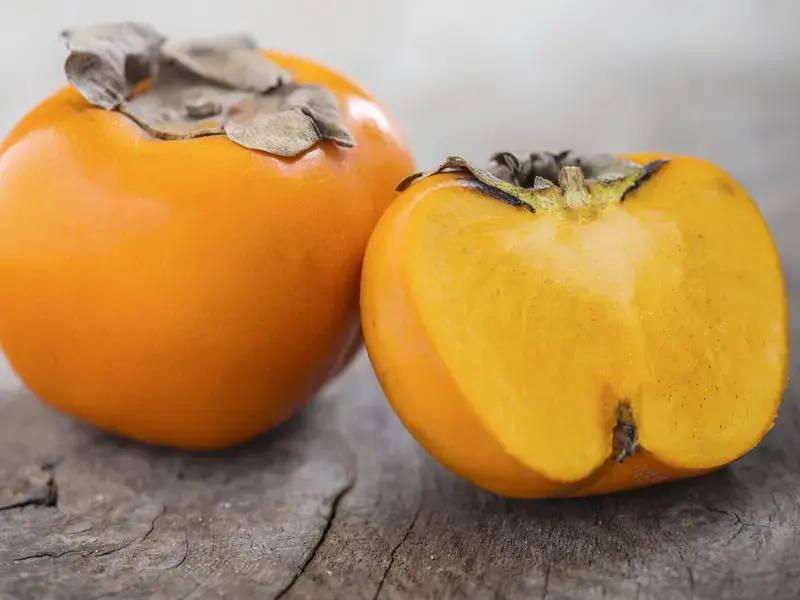
- Fuyu persimmons: squat and tomato-shaped, often eaten while still firm and crisp
- Hachiya persimmons: more elongated and acorn-shaped, famously astringent until fully soft
Fuyu persimmons are considered “non-astringent”, which means you can bite into them like an apple when they are bright orange and still hold their shape. Hachiya persimmons are “astringent”: they contain high levels of tannins that make the fruit intensely mouth-puckering until it is fully ripe and jelly-soft.
Beyond these two, there are many more varieties and nuances: heirloom types, chocolate persimmons, and different culinary traditions around the world. If you are curious about the broader world of persimmons – from history to cultivation – it is worth exploring a deeper guide to 26 things to know about persimmon where these details are unpacked in full.
How to Tell If a Persimmon Is Ripe
Because Fuyu and Hachiya behave so differently, how to tell if a persimmon is ready to eat depends on which type you are holding.
For Fuyu persimmons:
- Color should be a rich, even orange with no large green patches.
- Texture can be crisp to slightly yielding when pressed gently with a fingertip.
- Flavor will be sweet and mild even when the fruit is still firm.
You can eat Fuyu persimmons at various stages: from crunchy, when they are almost like a floral apple, to tender and juicy with a more pronounced sweetness.
For Hachiya persimmons:
- Color again should be deep orange to red-orange.
- The fruit should feel extremely soft – almost liquid inside – when gently cupped in the palm.
- The skin may look slightly translucent or wrinkled and the fruit might sag or slump when picked up.
With Hachiya, softness is non-negotiable. If you wonder how to tell if a persimmon is ripe and your Hachiya still feels firm, the answer is simple: wait. An under-ripe Hachiya will be very astringent and unpleasantly drying on the palate.
If you accidentally cut into a Hachiya that is not fully ripe, you can still let it finish ripening: place it cut-side up on a plate at room temperature until completely jelly-soft before eating or cooking with it.
Do You Eat the Skin of a Persimmon?
One of the most common questions for first-timers is: do you eat the skin of a persimmon? The short answer is yes – as long as you have washed it well and you enjoy the texture.
- Fuyu skin is thin and usually pleasant to eat. When you are deciding how to eat a persimmon of this type, leaving the peel on keeps the slices intact and adds a bit of chew.
- Hachiya skin is technically edible, but the fruit is often so soft that the skin separates easily from the pulp. Many people prefer to scoop out the flesh with a spoon and leave the skin behind.
If you are cooking or baking with persimmons, you can adapt based on the recipe. For salads or crudo-style preparations where the fruit is sliced thin, keeping the peel on adds color and structure. For purées, sorbets, or puddings, peeling or scooping out the flesh yields a silkier texture.
As with any fruit, rinse persimmons under cool water and pat them dry before eating, especially if you plan to leave the skin on.