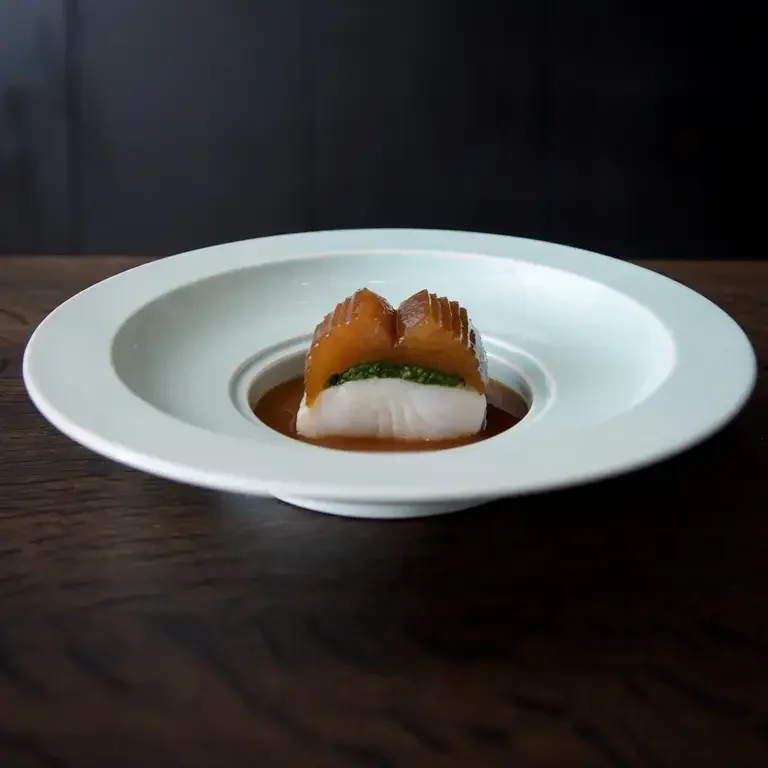

FOR THE INITIAL STOCK
Water: 1.5 L
Onions: 150 g (thinly sliced)
Ginger: 25 g (thinly sliced)
Daikon: 300 g (thinly sliced)
Garlic: 30 g (crushed)
Kombu: 25 g
Sake: 225 g (reduced from 450g)
Aged mirin: 150 g
Roasted halibut bones: 60 g
Fresh halibut trims, skin removed and roasted until golden brown: 200 g
FOR THE REMOUILLAGE
Water: 1 L
Reserved solids from the initial stock
FOR THE SEASONED STOCK
Finishing tamari: 70 g
Winter melon sugar: 63 g
Soy extract: 21 g
Korean black rice vinegar: 14 g
Salt: 2.8 g
Gochujang: 35 g
Oppowan chili pepper: 2.8 g
Italian anchovy essence (colatura): 28 g
FOR THE SAUCE
Seasoned stock (from above)
Xanthan gum: 0.15% by weight of seasoned stock
Ultratex 8: 1.5% by weight of seasoned stock
FOR THE BRAISED WINTER MELON
Winter melon
Seasoned Stock: equal weight to prepared winter melon
Salt: 2% of winter melon weight
FOR FINISHING
Reserved braising liquid : 20% by volume, combined with sauce
- Rinse the halibut bones thoroughly under cold running water.
- Place them in a large container, cover with plenty of cold water, and refrigerate overnight to remove any residual blood.
- The next day, drain the bones, pat them dry, and arrange them on a rack set over a sheet tray.
- Roast in a 400°F oven with a low fan, rotating the tray every 15 minutes, until the bones are evenly golden brown.
- Set aside.
- Roast the halibut trims separately in the oven until golden brown.
- Set aside.
- In a large pot, combine the water, onion, ginger, daikon, garlic, kombu, sake, and aged mirin.
- Bring to a boil, then reduce to a gentle simmer.
- Cover and cook for 50 minutes.
- Remove the pot from the heat and add the roasted halibut bones and roasted halibut trims.
- Allow the stock to steep for 20 minutes.
- Strain the stock through a towel-lined chinois or fine strainer, pressing gently to extract as much liquid as possible.
- Reserve both the liquid and the strained solids separately.
- Return the reserved solids to the pot and add the remaining 1 liter of water.
- Bring to a boil, then remove from the heat and allow to steep for 20 minutes.
- Strain the remouillage through a towel-lined strainer and combine it with the liquid from the initial stock.
- Return the combined stock to the pot and reduce gently until it reaches 1,400 g.
- Remove from the heat.
- While the stock is still warm, add the tamari, winter melon sugar, soy extract, Korean black rice vinegar, salt, gochujang, Oppowan chili pepper, and Italian anchovy essence.
- Allow the stock to steep for 5 minutes, then strain through a chinois.
- Chill completely.
- This seasoned stock will be used for both the sauce and the braised winter melon.
- Reheat a portion of the seasoned stock.
- While warm, thicken it with xanthan gum at 0.15 percent by weight and Ultratex 8 at 1.5 percent by weight, whisking thoroughly to avoid lumps.
- Once thickened, chill the sauce completely and set aside.
- Cut the winter melon into large blocks measuring approximately 16 cm by 10 cm, removing the seeds and skin.
- Weigh the prepared winter melon.
- Place it in a vacuum bag with an equal weight of the seasoned stock and add salt equal to 2 percent of the winter melon’s weight. Seal the bag.
- Cook the winter melon sous-vide at 194°F for 45 to 60 minutes, checking for tenderness at 45 minutes and continuing in 5-minute intervals if needed.
- Once tender, transfer the sealed bag to an ice bath and chill completely.
- Remove the winter melon from the braising liquid and cut it into smaller blocks measuring approximately 4.5 cm by 4.5 cm by 2 cm.
- Warm the sauce gently and combine it with 20 percent of the reserved braising liquid.
- Adjust seasoning if needed.
- Serve the winter melon warm, glazed with the finished sauce.