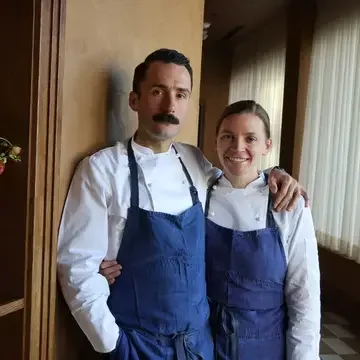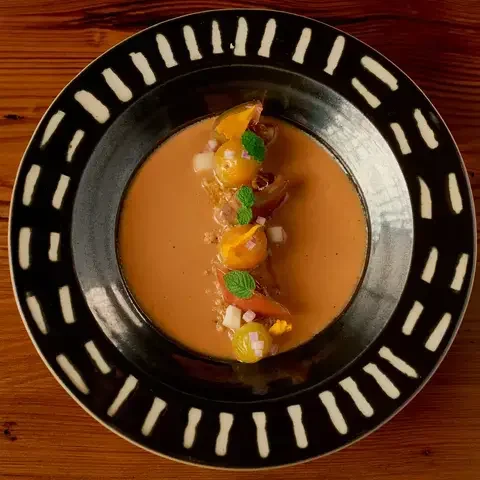

At Tomat in Los Angeles’s Westchester neighborhood, fermentation and sustainability are more than buzzwords: they shape how the restaurant operates. Partners in life and business, chef Harry Posner and Natalie Dial use preservation to extend the life of seasonal ingredients while developing flavors for their California menu. Peaches become tangy vinegars, banana peels become a housemade liqueur, and bran from milling rice becomes a pickling medium.
During a recent restaurant tour, Posner and Dial led me upstairs to their mad scientist-esque laboratory beside the pastry kitchen. Rows of glass jars held peaches, apricots, grapes, bananas, chiles, and garlic in various stages of curing, aging, infusing, and pickling. “Fermentation allows you to expand your pantry instantly,” Posner says. “You start with one ingredient, but then that one ingredient turns into 10,000 different options.” In a corner stood a covered vat of koji, made by growing mold on grains such as rice. “We’ve been making this koji with our in-house milled rice,” Posner explains. “Right now, we’re using it to give our pastries a little boost in the mornings.”
Tomat also makes its own miso, vinegar, and bitters. Corn inoculated with koji mold is used to make miso with cacao, while grapes are pickled for a caper-like garnish. To avoid the expense of buying rice bran for pickling, Posner and Dial decided to mill their own rice and collect the bran as a byproduct. Before purchasing a product, they consider whether they can make it using what they already have. “It really makes our day-to-day more worthwhile,” Posner says. “Nothing gets tossed, and we can have a lot of fun with the stuff that we get.”
Tomat sources ingredients from local farmers and grows produce in its own nearby urban garden. Preservation lets the restaurant take on surplus from its own harvests and from farmers who have more produce than they can sell. A hundred pounds of peaches might be too much to use immediately, but a pantry designed around preservation gives the kitchen time to work through them. “Farmers will be like, ‘Oh, well we’ve got pounds upon pounds of this or that, and you can have it for next to nothing. Do you want it?’ And we’re like, ‘Yeah, of course we do,’” Posner says.