This interview has been edited and condensed for length and clarity.
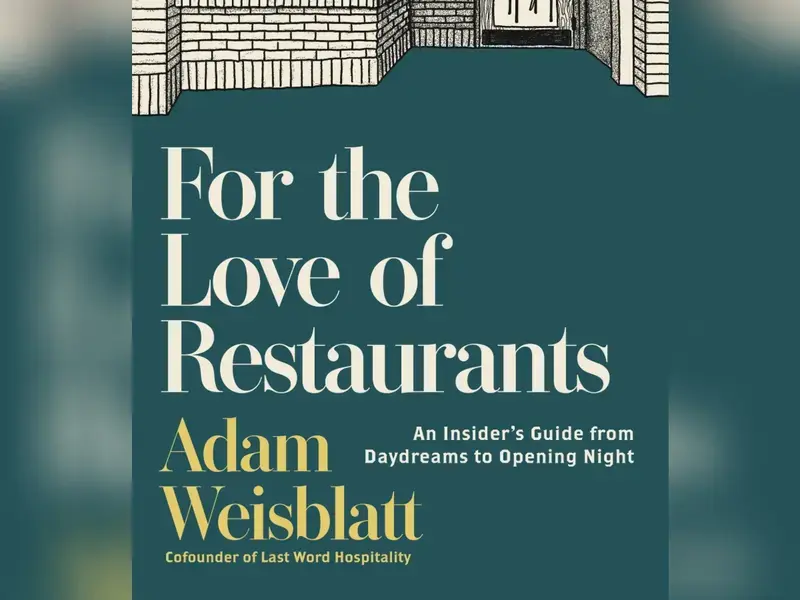
After the loss of your best friend, you write, “And with great loss, I craved birth. I wanted to make something new.” Why did that something new become a guide to opening a restaurant, and who did you imagine reading it?
When I was 25, I had already worked in restaurants for 10 years. . . . The options before me felt very much like: you either can go work [at] a mom-and-pop and just kind of survive, or you can go work a corporate career. But I knew very little, if anything, about entrepreneurship, and the very idea of owning a restaurant was impossible to me when I was young. I just didn’t know anyone who owned one.
Looking back, from the time I read Setting the Table by Danny Meyer and a few other books that I thought were amazing at teaching people hospitality, they didn’t necessarily teach you the other stuff that maybe you’d learn if you were getting your MBA. . . . If you were spending every day working in a restaurant, you were not learning what it meant to find a lease and negotiate one and raise money and all these other things that are required to open your own place.
When I really felt more serious about my career in my mid-20s, I did go looking for a book of “How do you open your own restaurant?” and I didn’t find it. And I kept looking, and over time, just felt like that was the gap that I wanted to try to fill. And that’s really what started it. It was not necessarily trying to tell the story, but trying to create a curriculum of what it meant to go from point A to point B, cooking or waiting tables to being an actual owner.
The book is candid about your uncertainty, failures, and the vulnerability you felt moving from restaurant consultant to owner. Did that openness come naturally?
I think growing up in New England, humility is a highly desired trait. I think that’s something that comes through in most of what I do. I think to be successful in restaurants, you have to have humility and [an] understanding [of] how many good operators there really are and how competitive it is. Not just because running a restaurant is hard, [but] because [of] how many people are good at doing it.
In writing the book, I never felt in any of my career that the reason why I was successful was for any one reason. It’s been a series of many different things, and I think with that, you have to take into account what was lucky, what was other people, and what was fortuitous based on timing. . . .
Yes, I think it’s much more relatable for people to hear about what sucked than every time you win, right? Most of us know what it feels like to have a shitty day, and a great day is more of a vacation-based idea.
You describe raising money for a restaurant as a process filled with rejection. How did you get through it?
A lifetime of waiting tables or bartending or cooking sets you up to deal with difficult situations and uncomfortable realities. If you spent your life waiting tables, you’ll have a million stories of people that you had to take care of who treated you like shit and made it uncomfortable. You’re used to dealing with that. That’s your job, to navigate humans. . . .
From restaurants, I’m just accustomed to losing or failing. And to raise money for an industry where everybody’s financial advisor is telling them not to do it, there’s no way to say it other than either you need to be really wealthy or you need to have really thick skin. . . . People say “no,” and they say you’re wrong, and you have to believe in yourself to know that if I’m willing to put all this time and money and effort into something, that I believe I’m right. A lot of people are going to tell you [you’re] wrong, even if you’re right. And you have to just be willing to believe.
The book also emphasizes accepting “no” and letting go, as with the East Coast roast beef sandwiches you envisioned for Found Oyster. How do you know when to abandon an idea?
There’s going to be an infinite series of puzzles you are faced with, from whether a dish is selling well to whether staffing is going well or whether guests would like it or anything else. Those are each going to result in you making a decision, one way or another, about whether to carry on or whether to give up. I think maybe the most important thing to at least accept is that either of them are admirable, right?
Both require a certain amount of bravery and a certain amount of trust and faith, including throwing in the towel. That also requires bravery, and it also requires decision-making, and it requires faith and trust in yourself that you’re making the right decision.
The book argues for dismantling traditional restaurant hierarchies, from the brigade system and the division between front and back of house to making key employees partners. Are general managers becoming partners more often, and should they be?
No, I don’t think it’s a trend yet. But I do think that it should be. I think that we get very caught up in the idea of systems over people. . . . But in restaurants, the product itself is so inconsistent. You know, like there’s no such thing as an oyster. Each oyster is completely different, even from the same batch of the same farm. . . . As a result, human beings have to make decisions all the time for restaurants to be successful. And thus, I don’t think there’s anything worth prioritizing more than talent.
A chef on their own is only 50% of the equation of what it’s going to take to make a restaurant successful, and I think what a general manager does doesn’t show up on Instagram. It doesn’t photograph well. It doesn’t make for great TV. But in terms of making a great restaurant, it is [of] the utmost importance that they are there, that they care, that they are capable and good, and can help shape the culture and support a chef in executing everything from the menu to service to just maintaining the physical reality of a building that’s going to take such a beating.
And so for us, if a restaurant only has a chef, it’s not ready. We need a chef partner, and we need a managing partner, and it’s the two of them together at a minimum that produce what it takes to run a restaurant successfully.
You advocate sharing equity with key employees. What risks or downsides come with that structure, and would you always recommend it?
I would always recommend a “human-first” approach, including at the equity table. But I do think that [it depends on] the length of time that you have known someone, how long you’ve worked with them, your comfortability with each other, and whether trust has really been formed or whether you’re testing that and hoping that it’s going to build.
There are lots of different ways to create a partnership deal. Some [give] everybody an equal part on the first day, and that would be the simplest. And [in] other ones, people get a piece [that] they earn over time, which for us is called vesting. I think that that’s a really important tool to get someone in who may or may not, at this very moment, have all the tools necessary to be a partner and to be a chef or general manager, but [in] whom you believe. The idea of someone earning their equity over a period of three years, if they stay, is [that it is] often the amount of time it’s going to take for them to mature fully into being capable of everything the job requires.
I think that whenever you’re picking partners, you need to be careful because this is a serious relationship, and it is on paper. These things are very real, and they can go very wrong and do all the time. . . . But I think that if you’re not willing to figure out how it’s going to work, then the restaurant business just may not be for you.
I just think it’s a super collaborative industry, and so many people fail because they find themselves on an island that they don’t know how to swim away from, and it’s because they’re alone. Being alone in a business that’s open seven days a week, where just running it is so hard, not to mention growing it and making strategic decisions about how it’s going to change and expand, is nearly, if not truly, impossible. And at least, if it is possible, you will have no life whatsoever to do anything else.
Your partnership with Holly Fox runs throughout the book. What should someone consider when choosing a business partner?
I think that if you are choosing one, like I did with Holly and Holly did with me, this is going to be your main partner, and you’re going to go into this together. There [are] a few things you need to agree upon from the beginning. I don’t think Holly and I did any of this because it was so loose, and we just kind of thought we’d wing it. But it turned out to be true by chance.
We have similar goals, similar dreams of what we wanted to make. Not what we wanted to work on at the beginning, but where we wanted to get to and what we wanted to make long term. Two is timing and understanding that a lot of sacrifices are going to be needed to make a small company start and be successful. When we started, I didn’t have a son, and we were both in a position to risk anything that we had. That is super important: that the timing is right, that both people are in the same place in their lives and willing to take similar risks.
And then the last, and certainly as important, in fact, the most important, is you genuinely need to be prepared and want to spend huge amounts of time together. To be really good, this relationship is going to be as committed and deep as anything else in your life outside of maybe your romantic partner if you’re married and raising kids. [It is] a complicated, deep relationship [that] will face immense challenges. There’s no getting around that. There will be times where the relationship is strained. . . .
But I do think great relationships are built through strength, and when people stick together through times that suck, that’s when they know they’re capable of being together and really are great together. Everybody gets along great when things are good. That’s easy. . . . But when everybody says you suck and you’re losing money and things are hard and you don’t necessarily know what to do, the willingness to lose with someone else and to take a beating with someone else, and [for] both of you [to] be okay with that, is based on a genuine desire to spend a lot of quality time with each other.
Why is getting permits to open a restaurant such a ridiculous process?
People say, “If you want to understand a situation, just look at who benefits, and then that will give you the answer.” I cannot tell you who benefits from the way things are. I have yet to figure out anyone who makes more money or has more time or does better in life by things being the way they are. . . .
I think that it’s just the bureaucracy in some places. LA, being a great example, is so large that what often starts out as well-intentioned ideas in practice become convoluted and complicated and thus [hurt] everyone they were originally meant to protect. It’s just well-intentioned ideas gone awry.
You write about “restaurant people” as a group encompassing different personalities and backgrounds. What defines a restaurant person beyond working in a restaurant?
The industry still attracts a lot of the same kind of, for lack of a better word, big characters, people whose personalities are really full and committed and unique. . . . I think basically just by the simple fact that you work on the days [when] everybody else doesn’t puts you in a subculture that is special and banded together.