Pizzeria Beddia Dough

Cool water: 355 g
Sugar: 2 tsp
Active dry yeast: 1/2 tsp
Extra virgin olive oil: 1 tbsp
All purpose or bread flour: 500 g
Fine sea salt: 1 tbsp + 1/2 tsp
Pizza is bread. It’s really simple and a little complicated at the same time. Dough takes planning to develop good flavor, and if you do it right you’ll thank me later. You can make dough with a sourdough starter, but I’ve found that a nice, slow fermentation is more consistent and the results are always perfect. Sourdough can be unpredictable.
Find yourself a nice all-purpose or bread flour. I use organic flour, but regular King Arthur is fine. Traditionally, four ingredients are used in making dough (flour, water, salt, and yeast), but we’re adding sugar to help with fermentation and a little oil to relax and fatten the dough.
It took me a couple of years to come up with this process, which produces a dough with excellent flavor, a crispy exterior, and a chewy interior. These measurements are in metric, as traditional Italian recipes always are. This is how I initially learned how to do it. They are more exact, which is vital in baking.
Important note while making dough: Turn your phone off and don’t speak; it’s a great time to listen, it’s a great time for new ideas, it’s not busy, you are present, and you are somewhere else. Making dough should be a calming, meditative process and a great time to think of new ideas about pizza, or about life in general
(From Pizza Camp by Joe Beddia. Copyright © 2017. Reprinted by permission of ABRAMS)
Start out by whisking the water with the sugar and yeast in a large stainless-steel bowl. Next, mix in the olive oil. Then we’ll mix in the flour. A large, strong spoon is good, or you can use your hands. If you have a stand mixer with a dough hook attachment, use that and mix for about five minutes on a slow speed, until everything is just incorporated. After everything is mixed and there aren’t any dry parts, scrape any remaining dough down the sides and cover the bowl with plastic wrap or a damp kitchen towel. Let it rest for 30 minutes. This will give the gluten structure and strength. The dough will become elastic.
Next, add the salt into the dough until the dough is smooth and the salt is fully incorporated, using wet hands (this makes handling it easier) or a dough scraper. Gently fold the dough over onto itself. You do not want to mix in the salt early on because
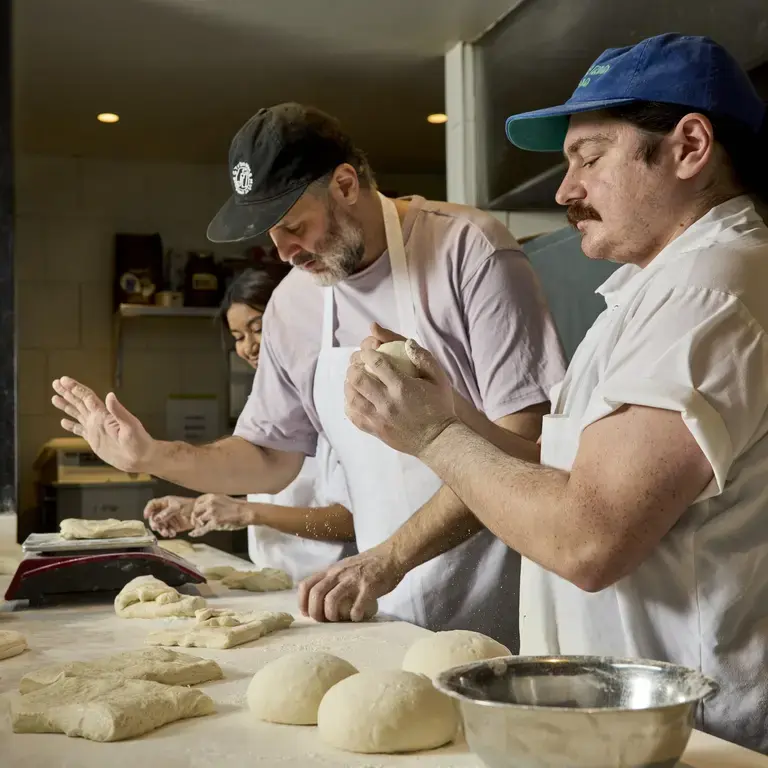
After the dough has chilled for 24 hours, take it out of the fridge and scrape it out onto a well-floured, clean counter. From here, you want to shape the entire thing into one big ball. With well-floured hands, grab either end of the dough mass and pull them up to meet in the middle. Rotate the dough mass one quarter turn and repeat. You’re basically incorporating the dough into itself to form one smooth ball. Flip the whole thing over, then, using a knife or bench scraper, cut the dough in half. You can weigh it to keep it even or eyeball it. I weigh everything to keep it kosher.
With well-floured hands, take one half of the dough and fold it over on itself, essentially repeating the same shaping technique with each half, until you have a round, extremely smooth-surfaced ball. Consistency here is important, and it takes some practice to get it right, so don’t get discouraged if it takes a few tries. If the dough gets sticky or tacky while you’re working it, dust it with more flour. After you have a smooth dough ball, set it on a floured surface and let it sit, covered with a kitchen towel, until it doubles in size. The climate, including temperature and humidity, plays a huge role in how fast this process happens. It should take approximately three to four hours. Just remember the goal is for it to double in size—that’s when you know the dough is ready. It should feel smooth at this point, and it should rise back slowly when you press into it with your finger.
If you’re not ready to make pizza right away, you can put the dough back in the fridge in a sealed container for another slow rise, but don’t keep it in there for more than 24 hours, or it will begin to sour and become hard to work with.